
The most useful stablecoin developments in this November 26, 2026 update concern US rule implementation, newly dated reserve evidence and announced payment expansion. They change different decisions: which rules apply, what a report covers and whether a service is actually available to you.
A partnership announcement is not a license, and a reserve report is not a live guarantee. Read each item with its own date and scope before treating a positive industry headline as evidence that a particular token or account has become safer.
US implementation has a future effective date
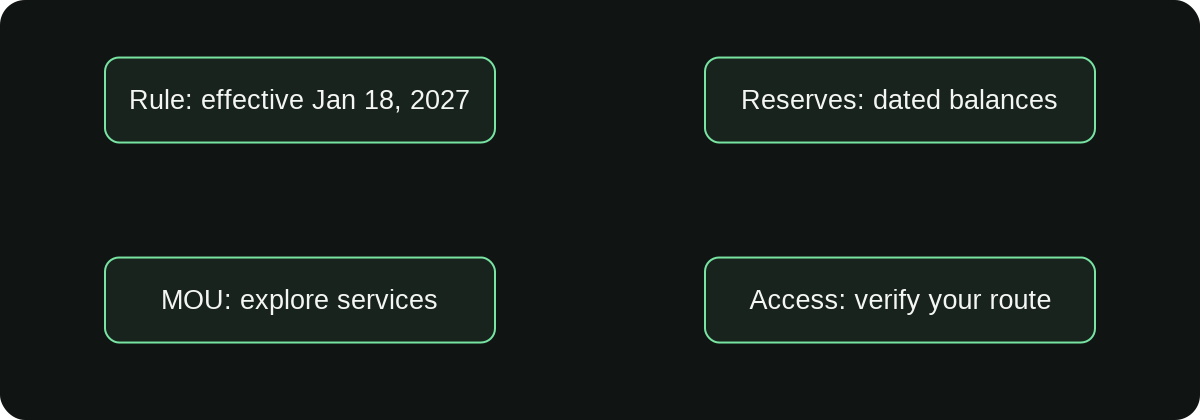
The OCC’s October 21 announcement describes a final GENIUS Act implementing rule within the agency’s jurisdiction. It states that the rule and Act take effect on January 18, 2027. As of this update, publication and effectiveness are therefore different milestones.
The announcement also separates certain anti-money-laundering and sanctions matters into coordinated rulemaking. It should not be paraphrased as a declaration that every stablecoin company, foreign issuer or service has already received universal authorization.
For a user, the immediate question is the status of the actual issuer and service in the relevant location. Check the current register, legal entity and product terms. Do not infer an individual company’s permission from the existence of a national framework or a headline saying regulation has arrived.
Reserve updates use their own reporting clocks
Tether’s October 30 release publishes a September 30 reserve snapshot. Circle’s October USDC examination report is dated November 25 and addresses specified October reporting dates. Neither should be relabeled a November 26 real-time balance sheet.
The document date, asset-measurement date and date you read it answer different questions. A newer publication can still describe an older balance. A weekly dashboard and a monthly assurance report can also serve different purposes without one replacing the other.
For a comparison, align the subjects and dates before ranking the figures. A company profit number is not the same as token-holder reserves, while a reported excess of assets over liabilities does not directly measure how quickly every retail holder can obtain bank money.
Expansion announcements are not automatic retail access
On November 25, Tether announced an investment in Lemon intended to support digital-asset use cases in Latin America. The announcement concerns a corporate investment and stated development aims, not a universal new deposit or withdrawal route for every resident.
Circle and Paribu’s November 24 announcement describes a memorandum of understanding to explore opportunities in Türkiye. An MOU is not proof that all proposed services are live or that users have acquired new legal rights.
Before sending funds through a service mentioned in a news story, confirm the launch status, eligible customers, supported networks and bank-processing conditions. The meaningful update for a sender is an available end-to-end route, not simply the number of partnerships named in an announcement.
Match each headline with the decision it can support
Different news categories require different evidence. A new network integration matters only if your receiving service supports the correct token version. A regulatory decision must be read by jurisdiction and entity. A reserve statement needs its accounting and assurance scope.
| Headline category | Decision it may affect | What to verify next |
|---|---|---|
| Rule or authorization | Whether an issuer or service can provide a particular activity | Effective date, entity, location and permitted scope |
| Reserve disclosure | How backing is reported for a specified date | Assets, liabilities, criteria and independent conclusion |
| Network support | Whether a transfer route works | Official identifier, version and destination support |
| Partnership or investment | Whether a service might expand | Actual availability and terms for eligible users |
This prevents one favorable announcement from being used to answer every question. An integration can improve access without changing the issuer’s reserve structure, while a new report can improve transparency without changing a wallet’s security.
Interpret price and supply news separately
A stablecoin trading below its target raises a different question from one whose circulating supply has declined. Price changes can reflect liquidity or confidence, while supply can change through issuance and redemption. A supply contraction alone does not prove insolvency.
Likewise, growth does not establish safe reserves or authentic demand for payments. Transfers can involve trading, internal movements or repeated activity. A claim about real-world adoption needs a definition and evidence beyond a market-cap chart.
The depeg explanation and market-cap guide keep these tasks separate. A dated price observation should identify the venue and quote asset; a total supply figure should identify the provider’s coverage and treatment of bridged assets.
Create a practical update routine
Maintain a short watchlist for the stablecoins and routes you actually use. Record issuer disclosures, redemption changes, network notices and relevant service restrictions. Check the original announcement when an item changes your ability to receive, move or withdraw funds.
Do not refresh the whole investment view after every repost. Several headlines can repeat one source, and an article updated today can describe an older event. Compare the first public source with the previous version to identify the genuine change.
For a pending payment, prioritize service status and the recipient’s current instructions over broad industry sentiment. For a larger holding, prioritize custody, reserve evidence and available exits. The same news feed can serve both users only if their decisions remain distinct.
What this update means for action
The documented developments support targeted checks rather than a blanket instruction to buy. Read the effective rules for the relevant location, inspect reserve dates and confirm that an announced service is operational for your account.
Keep the source link and date beside any change to your plan. If the facts do not alter the task or its risks, no transaction is required simply because the industry is making news. Information is useful when it resolves a decision, not when it creates pressure to act.
Frequently asked questions
Can a company announcement prove a service is approved by every regulator?
No. Identify the regulator, legal entity and activity covered by the relevant authorization. Commercial cooperation and regulatory permission are different kinds of evidence.
Should I treat a news aggregator’s timestamp as the event date?
Check the original release. The aggregator may show publication, syndication or revision time. Preserve the date of the underlying action and the time the information became public where they matter.
Does an unanswered rumor deserve a transaction before confirmation?
A rumor should remain labeled unverified. Assess the existing exposure and available evidence without treating urgency as proof. A decision made under uncertainty still needs realistic costs, loss capacity and a usable execution route.