
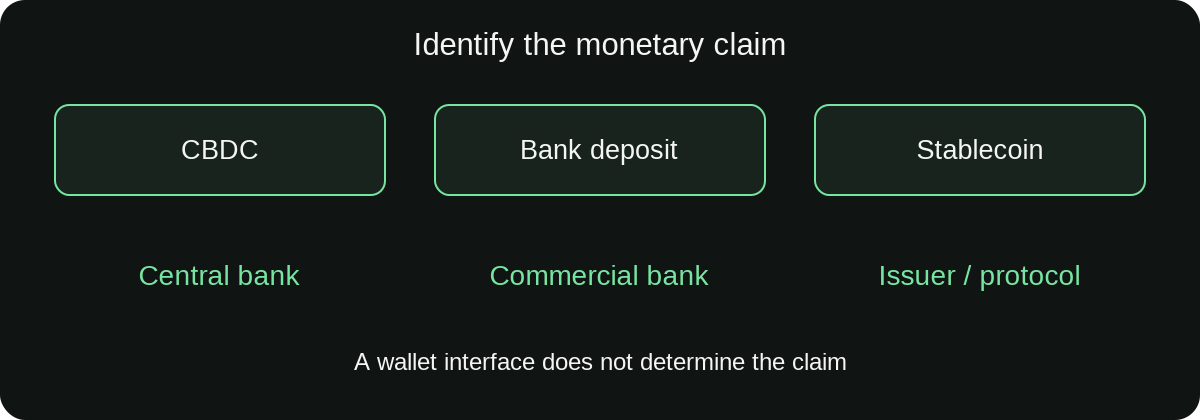
A central bank digital currency is a form of central bank money; a stablecoin is a privately issued or protocol-based asset designed to track a reference value. The most important difference is the underlying claim, not whether both appear in a digital wallet.
A CBDC proposal also differs from a live public service. Before comparing features, establish whether the project is research, a pilot or an operational arrangement available to the users you have in mind.
Compare the claim before the technology
With a CBDC, the relevant monetary liability is associated with the central bank. With a private stablecoin, examine the issuer or protocol arrangement, backing and holder rights. A commercial bank deposit introduces another type of claim against a bank.
These categories can use similar-looking interfaces while offering different protections. A wallet app, QR code or instantaneous transfer animation does not reveal who owes the money or what happens if an intermediary fails.
The European Commission’s digital-euro FAQ describes the proposed digital euro as central bank money. That is a structural distinction from a token that seeks to maintain parity through privately managed assets or incentives.
Do not extend that distinction into a claim that every CBDC design has identical limits, privacy settings or access rules. Those details depend on the particular system and its governing framework.
Retail and wholesale projects serve different users
A retail CBDC is intended for public-facing use under the relevant design. A wholesale arrangement focuses on eligible financial institutions or settlement functions. An institution participating in a trial does not establish that individuals can open a wallet today.
Stablecoin services also vary by user category. Institutional minting and redemption can be available where a retail holder must rely on an exchange. Both categories therefore need an access check, even though their underlying monetary claims differ.
When comparing announcements, write down the actual participants and permitted transactions. A successful interbank test is evidence about that test, not a universal consumer product launch. A retail interface demonstration is not proof that the final legal framework has been adopted.
This participant-level approach prevents a common reading error: assuming that any news about digital money means a new asset is freely available for purchase or investment.
The digital euro remains a conditional project example
As checked on November 26, 2026, the ECB’s project page describes preparation for a potential first issuance during 2029, conditional on the necessary EU legislation being adopted in 2026. That is a stated aim with conditions, not a completed launch.
The ECB describes the proposed instrument as complementing banknotes and coins. A reader should not turn it into a claim that cash has already been abolished or that an investable “digital euro coin” must be purchased through an exchange.
This example shows why verbs matter. Preparing, piloting, proposing and issuing refer to different stages. Preserve the stage and date when reporting a digital-currency development.
Be particularly cautious about unsolicited presales using an official-sounding name. A legitimate central-bank project announcement does not validate a private token claiming to represent early access. Check the authority’s own public information independently.
Compare practical properties separately
Use a matrix that separates design from implementation:
| Question | CBDC investigation | Stablecoin investigation |
|---|---|---|
| Who supports the claim? | Central bank and system framework | Issuer or protocol and backing arrangement |
| Who may use it? | Retail or wholesale eligibility | Platform, issuer and jurisdiction access |
| How does settlement work? | Particular system and intermediaries | Chain, token and service processing |
| What privacy applies? | Published design and legal safeguards | Public-chain visibility and provider data practices |
| Can it earn a return? | Specific design, not assumption | Separate reward or financial product terms |
Neither column can be completed accurately from the word digital alone. Read the project or product documents and distinguish announced intentions from functions operating now.
Privacy deserves especially careful wording. A public blockchain can expose transaction relationships without displaying a person’s name directly. A CBDC design may use intermediaries and specific privacy safeguards. Neither “fully anonymous” nor “total surveillance” should be assumed without evidence.
Settlement speed does not answer every payment question
A transfer can be fast within a system while funding and cash-out take longer. Recipient acceptance, identity requirements and cross-border rules still shape the complete route. Compare the time until the recipient has usable value, not only the time until a ledger updates.
For stablecoins, issuer redemption and market selling can differ. For a CBDC, access and conversion depend on its actual design and rollout. A future project’s intended feature should not be compared with another product’s measured worst-case performance as though both were current observations.
If your task is a remittance, compare an available payment service rather than waiting for a proposed system to solve today’s transfer. The cross-border guide provides that end-to-end framework.
Neither category removes the need to identify intermediaries
Even when the monetary claim is on a central bank, an app or service can introduce operational, device and support questions. With stablecoins, issuer, wallet, exchange and application risks may all be relevant.
Record which party holds credentials, handles complaints and processes conversion. That reveals where a failed device, stolen identity or interrupted service needs to be addressed. Monetary design and customer-service arrangements are related but not identical.
For users choosing an instrument now, start with the real need: everyday payments, access to a foreign currency, on-chain collateral or short-term cash management. The alternatives guide compares instruments by task rather than assuming one digital-money category replaces every other one.
Questions that clarify the comparison
Does a CBDC have to use a public blockchain?
No. Central bank digital money can be implemented through different technical architectures. Verify the project’s design rather than treating public-chain tokenization as a defining requirement.
Is a tokenized commercial bank deposit automatically a CBDC?
No. A different technical representation does not change a commercial-bank claim into central-bank money. Identify the issuer and liability, then review the applicable deposit and transfer terms.
Does a central bank guarantee purchasing power against every foreign currency?
No. A unit of domestic money can change in exchange value and real purchasing power. Monetary claim and currency risk are distinct questions, even when the instrument does not have a private stablecoin peg mechanism.