
Stablecoin transactions can create tax or reporting obligations even when the token stays close to one dollar. The answer depends on your tax jurisdiction, the transaction and your accounting basis. There is no worldwide rule that stablecoins are tax-free digital cash.
This guide provides a recordkeeping and classification workflow, with US and UK examples checked on November 26, 2026. It does not calculate an individual liability or apply either country’s rules to readers elsewhere.
Determine the taxpayer and jurisdiction first
Establish whether the activity belongs to you personally, a business or another legal entity. Identify the relevant tax residence and tax year. Moving between countries, receiving business payments or acting for a company can change the analysis substantially.
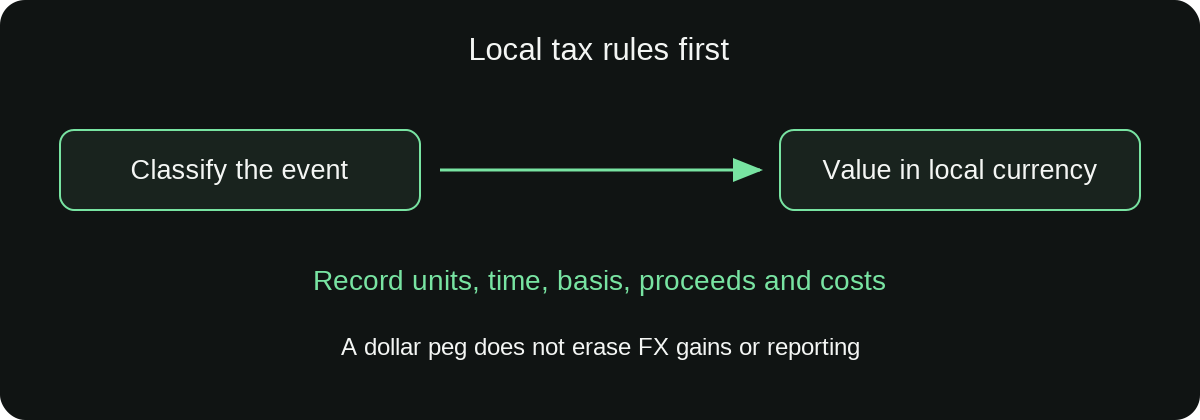
The currency used for tax calculations also matters. A dollar-linked token can remain near $1 while its value changes against sterling or another reporting currency. A stable dollar price therefore does not establish that a disposal produces no local-currency gain.
Do not use a foreign exchange’s account location as the sole answer to where tax applies. Your obligations can remain even when records are held overseas. Begin with the relevant authority’s current guidance and obtain local advice for unresolved situations.
Classify the event before calculating it
Separate acquisitions, disposals, income receipts and movements between accounts you own. A swap into another stablecoin is economically different from moving the same asset between your own addresses. A reward is different from returning your original deposit.
Use this event log as a starting point:
| Event | Information to retain | Question to resolve locally |
|---|---|---|
| Buy with fiat | Units, total cost, fees and time | How acquisition basis is established |
| Sell, spend or swap | Proceeds, consideration and costs | Whether a disposal arises and how it is valued |
| Receive a reward | Units, control date and value | Income timing and later basis |
| Transfer between own accounts | Both addresses and transaction hash | How ownership continuity and fees are treated |
| Lose access or suffer theft | Evidence and recovery status | Whether and when relief is available |
This is a classification aid, not a table assigning one tax treatment everywhere. The legal character of a wrapper, lending position or business receipt can require additional analysis.
US example: property treatment and transaction records
The IRS digital-assets guidance includes stablecoins within the relevant digital-asset discussion and explains the need to report income and applicable dispositions. Dollar targeting does not provide a general exemption.
For a sale or disposal, the IRS identifies information including units, transaction time, fair market value and basis. Keep enough detail to identify the assets involved and support the method used for the return.
Do not equate a broker’s reporting threshold with a taxpayer exemption. A transaction omitted from a broker statement can still require analysis. Conversely, an aggregate proceeds figure is not itself your taxable gain.
For complex activity, reconcile the tax return with all wallets and platforms rather than relying on a single exchange export. A missing acquisition record can make a later sale appear to have no basis when the real problem is incomplete data.
UK example: disposal and sterling valuation
HMRC’s disposal guidance, updated October 5, 2026, describes selling, exchanging and using cryptoassets to pay as potential disposal events. The applicable exemptions, matching rules and wider circumstances still matter.
HMRC’s stablecoin taxation call for evidence discusses the existing difficulties, including foreign-currency-linked tokens fluctuating against sterling. A consultation should not be presented as an enacted change simply because it proposes simplifying treatment.
For illustration, suppose a UK individual acquires tokens for £800 and later disposes of them for £820 before costs. Their near-constant dollar price does not erase the £20 sterling difference. This example illustrates currency measurement, not a complete gain calculation under matching rules.
Keep the exchange-rate source and valuation timestamp used. Mixing a daily average for one event with an unexplained intraday quote for another can make reconciliation unnecessarily difficult.
Build a ledger that survives missing platform data
For each event, retain date and time zone, token and network, quantity, transaction hash or order identifier, counterparty where known, local-currency value, fees and the purpose of the movement. Preserve original exports alongside your working spreadsheet.
Link internal transfers so they are not accidentally counted as sales or income twice. For a swap, record both the disposed and received asset. For a withdrawal, reconcile trading proceeds, withdrawal charges and the eventual bank credit.
A basic realized-result worksheet is proceeds minus relevant basis and eligible costs. The arithmetic is straightforward; determining the correct basis, cost treatment and recognition time is where local rules matter.
If you pay network fees in another cryptocurrency, retain those quantities and values too. Do not assume that a stablecoin-only trading strategy produces no activity involving other assets.
Rewards and DeFi need their own review
A platform reward, lending return and savings-vault share increase may not be treated identically. Identify the legal arrangement and when you receive or control value. Later selling an asset can be a separate event from first receiving it.
Likewise, depositing into a wrapper may involve a different asset or claim. Do not assume every deposit is a tax-neutral transfer between your own wallets. The stablecoin rewards guide helps identify what product you are actually using.
For a completed bank exit, the cash-out checklist provides the settlement records needed to connect token activity with fiat proceeds. Paying money into a bank is not necessarily the only moment relevant for tax.
Questions for preparing a return
What if my exchange statement contains no local-currency values?
Retain the original quantities and timestamps, then use an appropriate documented valuation source under the relevant rules. Keep your conversion method consistent and preserve the source data rather than inventing rounded amounts.
Does a stablecoin loss automatically create deductible relief?
No. Realized loss, theft, worthlessness and temporary inaccessibility can have different treatment. Document the event and seek jurisdiction-specific guidance before entering a deduction merely because an app balance fell.
Should I pay a tax demand sent to my wallet through a message?
Verify any demand independently with the relevant authority. Tax compliance does not require giving a stranger your seed phrase or paying an unexplained token transfer to unlock an exchange balance.