
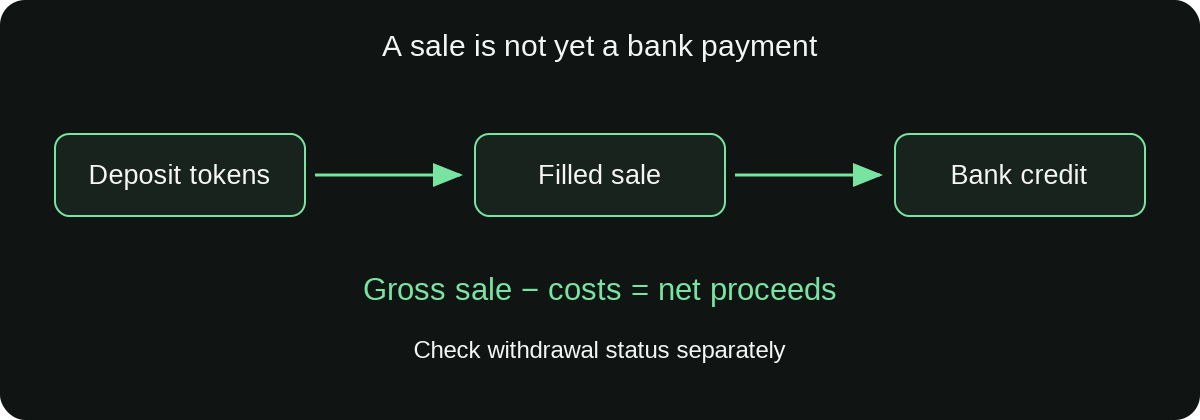
To cash out stablecoins, use an eligible service to sell the correct token, then withdraw the resulting fiat balance to your bank. Treat the sale and bank settlement as separate stages: completing one does not complete the other.
Before moving funds, confirm that the service accepts your residence, bank account, token and network. A trading pair on a public website is not evidence that your account has a working bank withdrawal route.
Establish a bank exit before depositing tokens
Open the withdrawal conditions first. Check supported currencies, minimum amounts, beneficiary rules, processing windows and any restrictions following a new deposit or account change. Confirm that your legal name matches the bank details where required.
Look for the service’s actual legal entity and authorization in your jurisdiction. Distinguish a licensed local operation from an unrelated brand page. Avoid a route that asks you to misdescribe payments or use somebody else’s bank account to bypass checks.
If your bank does not support the payout currency, determine whether it will convert the incoming money and at what cost. A USD sale followed by a poor bank conversion can produce less local money than a direct local-currency sale.
Prepare a source-of-funds file before a substantial withdrawal. Useful records include acquisition statements, wallet transfers and previous ownership evidence. You should be able to explain where the tokens came from without disclosing wallet secrets.
Choose between exchange selling and issuer redemption
An exchange sale transfers your tokens to another market participant at an available price. Issuer redemption follows a separate contractual process, potentially involving eligibility checks and minimums. Do not confuse a dollar target with universal direct redemption access.
For example, Tether’s published fee schedule sets a direct redemption minimum of $100,000, alongside relevant terms and verification requirements. Circle’s USDC information describes institutional access through Circle Mint. A retail holder may instead need an eligible exchange or payment provider.
These examples explain why finding the real exit matters. Neither a reserve report nor an attractive exchange quote guarantees your bank can receive proceeds today. Select the route you can actually complete rather than an inaccessible theoretical price.
Deposit using the receiving service’s instructions
Generate deposit details within your own verified account. Confirm the accepted asset, blockchain and any required reference. The same ticker can represent different contracts, bridged assets or unsupported versions. Matching an address format is insufficient.
Check minimum crediting amounts and required confirmations. A tiny transfer below the threshold can fail to establish that the route works. If you test, choose an appropriate amount and verify credited funds before sending more.
Save the deposit address, transaction hash and receiving-account record. If the balance does not appear, compare the on-chain status with the platform’s deposit conditions. Do not pay an unsolicited “activation tax” to an address sent through chat.
Moving funds between your own wallets generally does not sell them, but local tax and reporting rules still determine how transfers should be documented. Keep their purpose clear so that internal movements are not mistaken for unexplained income.
Read the order before accepting the sale
The executable bid matters more than a chart’s last trade. Review expected proceeds after trading fees and spread, especially for a large order or a thin local-currency market. A market order prioritizes execution but may fill at several prices.
A limit order controls the acceptable price but may remain unfilled or fill only partly. Record the actual filled quantity and the fiat balance received. An open order is not available bank money.
Use a calculation that matches your route:
Net bank proceeds = actual sale proceeds − trading charges − withdrawal costs − bank deductions.
If the displayed sale proceeds are already net of trading fees, do not subtract those fees again. Currency conversion may occur at the exchange, an intermediary bank or your own bank; locate it before comparing quotes.
For illustration only, selling 2,000 tokens at $0.999 produces $1,998 gross. A $2 trading charge and $5 withdrawal charge leave $1,991 before any bank costs or conversion. This is not a live quote or a claim about a particular provider.
Follow the withdrawal through bank credit
Enter the beneficiary details carefully and inspect the confirmation screen. Keep the amount, currency, reference, initiation time and expected settlement window. A service marking a withdrawal “processed” can mean it has handed the payment to another institution.
If the expected time passes, ask the provider for a traceable payment reference. Then ask the bank whether the incoming transfer is pending, rejected or awaiting information. Avoid repeatedly initiating replacements while the first payment remains unresolved.
Do not assume a token’s stable price means the resulting payment has special government protection. The FDIC’s crypto fact sheet distinguishes insured bank deposits from crypto-company failures. Coverage depends on the actual account and applicable conditions, not the token’s label.
Keep a cash-out record that can be reconciled
Your final file should connect the outgoing token quantity to the trade, fees and bank credit. Include timestamps and currencies so that another person can follow the sequence without guessing which exchange rate you used.
Retain original exports where possible, rather than relying only on a screenshot of the final balance. Stablecoin sales and conversions can have tax consequences even when the dollar price changes little, particularly where local-currency gains matter.
For an exchange between tokens rather than a bank exit, use the stablecoin swap guide. For payments to relatives abroad, the remittance workflow adds recipient-side checks that a personal cash-out does not require.
Cash-out questions that need separate answers
Can a withdrawal be returned after the exchange says it was sent?
Yes, a bank or payment intermediary may reject it. Ask how the service handles returned payments, fees and beneficiary corrections. Keep the original reference so a return is not mistaken for a missing second transfer.
Should I close my exchange account immediately after withdrawing?
Download statements and confirm settlement first. Closing too early can complicate access to tax documents or support records. Account closure also does not erase recordkeeping duties under local rules.
Can I cash out tokens held in a business wallet to my personal bank?
Do not assume that route is acceptable. Ownership, bookkeeping and provider beneficiary policies must align. Use the appropriate business account and obtain accounting guidance when company funds are involved.