
To swap stablecoins, compare the net destination amount, verify the exact token and choose an execution route you can use. A centralized exchange trades within its account system; a decentralized exchange uses wallet signatures and contracts. Neither guarantees a one-for-one conversion simply because both assets target a dollar.
Treat the swap as a complete instruction: what leaves, what arrives, where it arrives and what costs are charged separately. This prevents a favorable displayed exchange rate from hiding a withdrawal fee, unsupported network or permission you did not intend to grant.
Choose the route before comparing the headline rate
A CEX may offer an order book or an instant conversion quote. The first depends on available orders and your chosen instruction; the second supplies a quote with its own terms and validity period. A fill can change an internal balance without creating a new blockchain transfer for every trade.
A DEX usually requires the correct network, supported tokens and sufficient fee currency in the wallet. Its route can use one or several pools and contracts. The on-chain result follows the transaction and protocol rules, not a promise that the preview will remain unchanged indefinitely.
| Route | Main execution check | Additional issue |
|---|---|---|
| CEX order book | Bid, ask, depth and order type | Custody and subsequent withdrawal conditions |
| CEX conversion | Final quote and expiration | Spread or service charge embedded in the offer |
| DEX swap | Correct route, output terms and signature | Permissions, gas, contract and network risk |
If the destination requires another blockchain, an ordinary same-chain swap may not complete the task. A bridge or other transfer process adds separate dependencies. Do not assume that changing the ticker automatically changes the network.
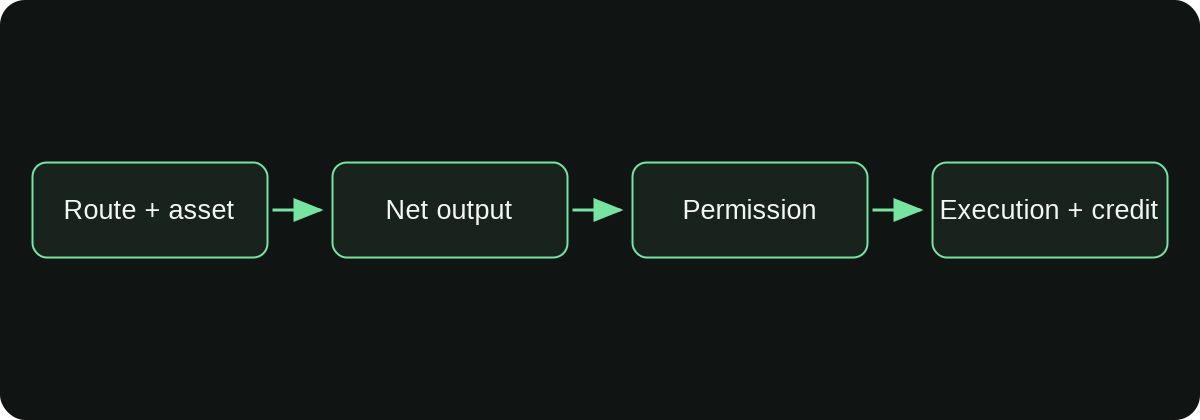
Calculate the amount that reaches the destination
Compare the quantity received after trade costs and any later transfer or withdrawal. If starting and ending in different currencies, include the relevant conversion. Use compatible quote times and the same final destination for each route.
For a hypothetical swap of 1,000 units, receiving 998 units at the trading stage is not the complete comparison if a later withdrawal removes another amount. Conversely, a route with an explicit fee can outperform one whose cost is hidden in the price.
Do not subtract a fee twice when it is already included in the displayed output. Read which charges are embedded and which require separate native currency. A dollar-targeted token can still move away from its target, so token quantities and dollar values should be recorded separately.
For a CEX swap, verify the executed balance
Confirm the selected pair and product. Spot conversion is different from a derivative position, a leveraged trade or an interest-bearing product. Check the direction so you are selling the intended asset rather than buying more of it.
Review the order or conversion preview, submit once and inspect the final status. An order can fill partially or remain working. Preserve the identifier, executed quantities, fees and any remaining order before sending a replacement instruction.
If the token is intended for withdrawal, check that function before the swap. A newly acquired balance can still face account, funding or network restrictions. The buying workflow explains why a completed trade and a completed exit are separate stages.
For a DEX swap, inspect identity and permissions
Verify the app address through a trusted source, connect the intended wallet and select the correct network. Compare the token’s official identifier with the asset in the swap interface. Names and icons can be copied.
An approval may let a contract spend tokens under the granted terms. Uniswap’s approval explanation distinguishes that permission from the swap itself. Check the spender and amount, and do not interpret a successful approval as proof that a conversion has already happened.
The wallet can also request a signature rather than a conventional on-chain approval transaction. Read what it authorizes. A gas-free signature is not automatically harmless, and a wallet connection alone should not require surrendering recovery material.
Understand slippage and minimum output
Slippage tolerance defines an acceptable difference under the transaction’s rules; it is not a forecast of the actual loss. Price impact from your order and market movement while the transaction waits can both affect the outcome.
In a simplified example, an expected output of 1,000 with a 0.5% tolerance gives a nominal threshold of 995, subject to the interface’s actual fee, rounding and execution conventions. The real preview and transaction terms govern the instruction, not this educational calculation.
Uniswap’s transaction-failure guidance explains how output changes can affect execution. Do not repeatedly raise tolerance without diagnosing the cause. A surprising quote can reflect low liquidity, the wrong asset or other conditions that a wider limit does not make safe.
Confirm the transaction and the actual token received
After signing, inspect the transaction identifier and status on the correct network. Distinguish pending, failed and confirmed transactions. A reverted on-chain action can still consume network fees even when the intended swap does not complete.
Compare the received asset identifier and quantity with the intended destination. A token can appear in a wallet display without being the genuine asset. Check the chain record and reconcile any remaining allowance or subsequent withdrawal requirement.
If the wallet balance does not refresh, verify the transaction before submitting another. A delayed interface update and a failed transaction require different responses. Keep records of the inputs, output, fees and relevant price rather than relying only on the final display total.
Complete the route rather than stopping at the swap
A successful exchange balance change or confirmed contract call may be only the middle step. If the user needs a bank receipt, another transfer or an application deposit, verify that final stage separately. The remaining restrictions can change the practical result.
For unused permissions, review whether they are still needed. The storage guide covers separating spending activity from reserves. A completed swap should leave a clear record of what happened and which access rights remain active.
Frequently asked questions
Can I cancel a pending DEX swap as easily as a CEX order?
Not necessarily. Network transaction replacement or cancellation depends on the chain, wallet and confirmation state, and can fail to win the race. Do not assume a cancellation request reverses an already confirmed transfer.
Does using a well-known aggregator remove contract risk?
No. Review the actual route and permissions, including any underlying contracts or bridge steps. Familiar branding does not guarantee every integration or output asset is appropriate for your task.
Should a failed approval make me grant an unlimited allowance?
Not automatically. Diagnose the error through genuine support and inspect the spender, token and fee conditions. A larger permission can increase exposure without solving the original technical or identity problem.