
“Stablecoin staking” is often a marketing label for lending, a savings vault, liquidity provision or a platform reward program. Holding USDT or USDC does not itself make you a validator or produce a guaranteed return. Identify the economic arrangement before comparing yields.
The practical question is not simply which advertised APY is highest. It is who pays, what claim you receive, when you can exit and what can cause your principal or rewards to lose value.
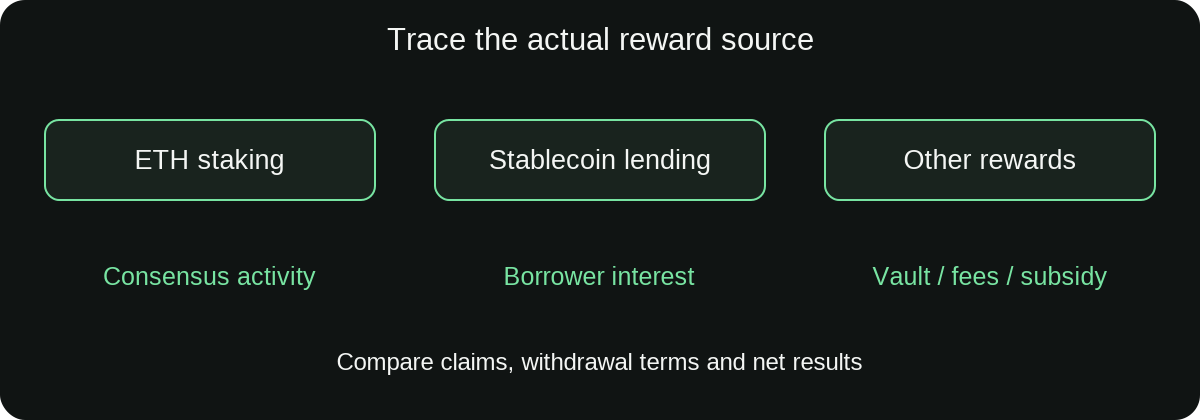
Distinguish consensus staking from a stablecoin product
On Ethereum, staking involves ETH and participation in the network’s validator system. An application accepting a dollar-targeted token is not automatically offering that same consensus function.
A lending platform may pay borrowers’ interest to suppliers. A vault may allocate assets across strategies. A promotional reward may be funded by a company. A liquidity pool may distribute trading fees and incentives.
Some products combine several arrangements. The label on the deposit button is therefore less informative than the legal terms, contract design and source of payments. Ask what happens to the stablecoins after you deposit them.
This distinction does not mean every product using the word staking is necessarily fraudulent. It means the description needs to be precise enough for you to understand the exposure rather than borrowing credibility from an unrelated mechanism.
Follow the money funding the reward
For a lending return, identify borrowers, collateral and market conditions. An elevated rate may reflect strong borrowing demand, incentives or a greater risk that you should investigate. The rate alone cannot identify which explanation applies.
For a platform reward, identify the payer, eligibility, limits and ability to change the program. An account incentive can differ from interest generated by assets you personally own. A temporary offer should not become a permanent income assumption.
For a savings vault, examine how shares accumulate value and what assets or activities support that accumulation. Sky’s sUSDS documentation describes a savings-token structure distinct from simply holding USDS. Use the current official mechanism rather than assuming a fixed one-token share price.
For liquidity provision, inspect the pool’s changing asset mix and fee model. A positive rewards counter can coexist with a loss on the withdrawn assets. The DeFi guide separates those activities in greater detail.
APR and APY require stated assumptions
APR is commonly used to express an annualized simple rate, while APY incorporates compounding under specified assumptions. Check the product’s own definitions, because promotional displays can include incentives or different conventions.
For illustration, a constant 5% nominal annual rate compounded daily would produce approximately 5.127% effective annual growth before costs. That calculation assumes an unchanged rate, daily reinvestment and no losses. It is not an available offer or a forecast.
Your intended holding period matters more than an annualized headline. At a hypothetical 5% simple annual rate, $1,000 held for 30 days generates about $4.11 before costs using a 365-day convention. Six dollars of total entry and exit costs would exceed that income.
Do not count volatile incentive tokens at a fixed future price. If rewards arrive in another asset, their realizable value can change before you sell them. Include that uncertainty separately from stablecoin-denominated income.
Determine what you own after depositing
You may receive a receipt token, vault share or custodial account balance. Each represents a different claim. Determine whether you can transfer it, what it can be redeemed for and which entity or contracts must perform.
A custody arrangement can expose you to the platform’s financial and operational condition. An on-chain arrangement can add software, oracle or collateral dependencies. Self-custody of a receipt token does not remove the risks inside the underlying product.
Aave’s risk documentation provides examples of smart-contract, collateral, liquidity and other protocol risks. Audit activity is a control, not a promise that a position cannot suffer a loss.
Do not assume every depositor has a borrower’s liquidation risk. A user who supplies without borrowing differs from someone who pledges assets and takes debt. Identify the actual position before applying a warning or calculating its sensitivity.
Read withdrawal conditions before the yield table
Check whether withdrawals are immediate, queued, limited by liquidity or subject to a cooldown. Determine whether a displayed available balance reflects an unconditional claim or only an interface estimate.
Also distinguish withdrawing from a product and selling the underlying stablecoin. You can successfully redeem a vault share yet receive a token trading below its target. You can receive that token in a wallet while still lacking a usable bank payout route.
Inspect the exit when market conditions are unfavorable, not only the normal process. What happens if utilization rises, the stablecoin depegs or a supporting bridge stops? A withdrawal policy needs to cover those questions rather than promise continuous access without conditions.
Keep enough resources for required network fees. An otherwise available withdrawal can be impractical if every asset is committed to the product and you cannot fund the transaction.
Compare net outcomes instead of advertised rates
Create one row per product with source of return, claim received, reward asset, withdrawal terms, costs and principal risks. Compare the same amount and intended duration. Do not rank products solely by an annualized percentage.
For a variable rate, evaluate a range and a no-reward scenario. Ask whether you would still accept the product’s risks if the promotional component disappeared. That exposes offers whose appeal depends entirely on a temporary subsidy.
Records matter too. Rewards, share conversions and later sales can raise different tax questions depending on jurisdiction. The tax workflow helps organize the events without assuming one global treatment.
If the purpose is emergency liquidity or a near-term bill, compare instruments designed for that task. The alternatives guide explains why a high-yield token product should not automatically replace accessible bank money.
Questions about reward claims
Can a stablecoin pay a return without my balance increasing?
Yes, a share-based arrangement may increase the amount of underlying assets represented by each share instead. Read its accounting and redemption mechanism before assuming an unchanged share count means no return.
Does a fixed lock period mean the rate is fixed too?
Not necessarily. The duration and rate are separate terms. Check whether rewards can change during the lock, what early exit permits and whether the return depends on another asset’s price.
Should an unusually high APY be treated as proof of a scam?
It is a reason for scrutiny, not a complete factual finding. Identify the funding source, sustainability and risks. If the explanation is unverifiable or depends on guaranteed appreciation, do not substitute the headline rate for evidence.