
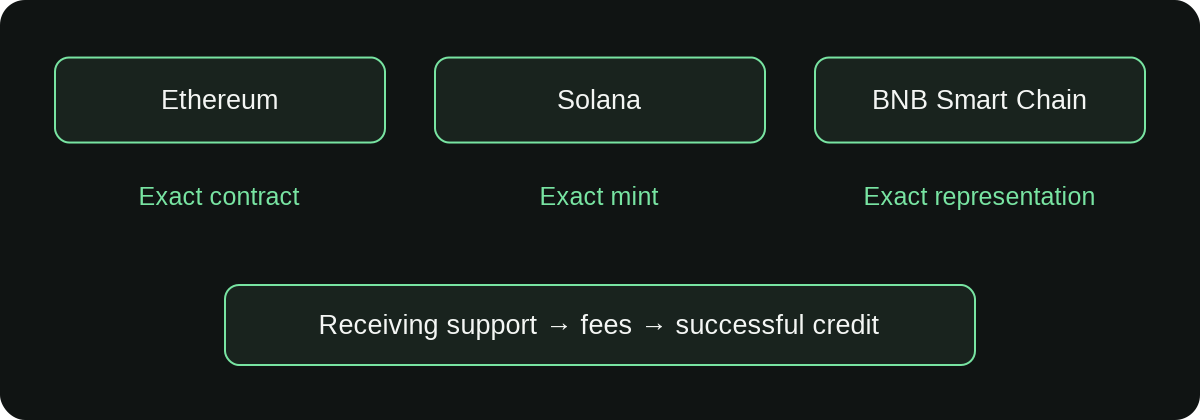
Choose a stablecoin network by the exact asset and the route both parties support, then compare costs. Ethereum, Solana and BNB Smart Chain are not interchangeable destinations, and the same ticker across them may refer to different issuance or bridging arrangements.
A cheap transfer to an unsupported deposit network can be more costly than a higher-fee route that works. Start with receiving instructions rather than a general ranking of blockchains.
Verify the asset independently of the chain name
A chain is infrastructure; a token is a particular asset deployed through contracts or token programs. A network supporting tokens does not establish that every familiar stablecoin on it is issued natively by the company you expect.
Circle’s official contract list, checked on November 26, identifies native USDC deployments on Ethereum and Solana. BNB Smart Chain did not appear in the retrieved mainnet list. Do not infer a native Circle issuance there from an exchange label or familiar USDC logo.
A bridged or exchange-pegged representation can depend on another operator holding assets and maintaining the conversion route. That is an additional claim to evaluate, not just a different transaction fee.
Use the issuer’s current documentation to identify the exact asset. If a product is not listed, seek clarification rather than filling the gap with a search result from an unrelated token project.
Ethereum: inspect the contract and gas budget
For native USDC on Ethereum, Circle lists the contract 0xA0b86991c6218b36c1d19D4a2e9Eb0cE3606eB48. Confirm the complete address through the live official reference before acting; a familiar beginning or ending is insufficient.
Ethereum token transfers normally require the sender to fund applicable network costs in ETH unless a service or supported mechanism handles them differently. Ethereum’s gas documentation explains why transaction complexity and network conditions affect costs.
Do not compare a simple transfer’s estimate with a swap involving approvals and several contract interactions as though they were the same operation. A route can require more than one transaction and therefore more than one charge.
Also distinguish Ethereum mainnet from its layer-2 networks. An address may look identical across several EVM networks, while a receiving service only supports one. Address format does not establish deposit compatibility.
Solana: verify the mint and receiving support
Circle lists native USDC’s Solana mint as EPjFWdd5AufqSSqeM2qN1xzybapC8G4wEGGkZwyTDt1v. Verify that identifier rather than relying solely on the symbol displayed by a wallet.
Solana uses a different transaction and account model from Ethereum. Its fee documentation describes network fees and optional priority components. A wallet or service can also encounter account-related requirements, so inspect the actual transaction preview.
Holding USDC does not automatically give you the native balance or service support needed for every later action. Determine who pays the fee and whether the destination accepts the token through the intended network.
A fast chain confirmation is also different from an exchange credit. The receiving service may impose its own confirmation, risk or maintenance conditions. Estimate the complete task duration, not only ledger processing.
BNB Smart Chain: ask who supports the representation
BNB Smart Chain, often called BSC, is one part of the broader BNB Chain ecosystem. For a stablecoin transfer there, inspect the specific contract and its issuing or bridging arrangement. Do not use the ecosystem name as the asset’s identity.
An exchange may offer deposits and withdrawals for a representation it supports. That availability does not independently prove direct redemption with the original stablecoin issuer. Read the exchange or bridge terms governing the representation.
Compare its supported exit with your actual destination. If the recipient needs native USDC on another chain, an extra bridge or swap may be required. Each added step introduces costs, permissions and possible operational failure.
Circle’s bridged-USDC explanation provides the relevant distinction between native and bridged forms. Apply the same provenance question to any other stablecoin instead of assuming every cross-chain copy has identical rights.
Compare the whole route on one worksheet
Record the token identifier, source network, destination support, expected received quantity, all costs and any required intermediate step. Use the same transfer size and observation time when comparing routes.
| Check | Why it can change the decision |
|---|---|
| Exact deposit asset | A service may reject a different contract or representation |
| Network availability | Maintenance or restrictions can block a normally supported route |
| Native fee funding | Tokens may arrive but be unusable for a later transaction |
| Minimum credit amount | A transfer can confirm without meeting deposit conditions |
| Bridge or swap requirement | Additional claims and costs can erase a cheap-transfer advantage |
Avoid publishing a fixed dollar-fee league table without a live, reproducible measurement method. Fees and provider charges change, and an exchange withdrawal charge is not the same as a network fee.
Test the receiving process before scaling
When appropriate, send a small amount above relevant crediting minimums. Verify the actual token received, account credit and intended onward use. A test below the minimum or on another network does not validate the planned larger route.
Save the transaction hash and the receiving instructions. If credit is delayed, compare on-chain success with the service’s conditions. Do not follow unsolicited messages offering to activate the deposit for an extra payment.
For buying and transferring, the purchase workflow puts destination support first. If a representation must be exchanged, use the swap guide to separate permissions, quoted output and final receipt.
The best network for a particular task is the supported route whose costs and dependencies you understand. That answer can differ between two recipients even when both use the same stablecoin brand.
Questions about network choice
Can a wallet showing my balance guarantee exchange recovery after a wrong-network transfer?
No. Wallet visibility and an exchange’s recovery ability are different. Recovery can depend on address control, technical support and policy, and may be unavailable. Confirm support before sending.
Does a lower confirmation time mean lower financial risk?
Not necessarily. Speed does not establish reserve quality, bridge security or recipient crediting. Evaluate those dimensions separately rather than using one performance measure as a complete safety ranking.
Should I bridge solely to save a small transfer fee?
Compare the additional approvals, bridge costs, conversion spread and exit conditions. A small quoted saving may not justify another dependency, especially when a direct supported route already completes the task.