
DAI is a dollar-targeting stablecoin originating in a collateralized protocol system. Its stability depends on collateral, incentives, governance and usable conversion routes. Understanding DAI today also requires understanding its connection to Sky and USDS, without treating the two tokens as identical assets.
Owning DAI is different from owning a governance token or depositing into a savings product. Those distinctions determine what you can do, what return you might receive and which risks you accept.
Begin with the difference between holding and creating DAI
A user can acquire existing DAI through a market without opening a collateralized debt position. The buyer then holds the token; they have not automatically borrowed against their own assets or taken on a vault repayment obligation.
Creating stablecoins through a collateralized vault is different. A user commits accepted collateral and generates debt subject to the system’s rules. Maintaining adequate collateralization and repaying debt are responsibilities of that position, not of every person who later receives its tokens.
The official Dai documentation describes the user-facing ERC-20 token and its relationship with the core accounting system. It also highlights permissions such as signed approvals. A familiar stablecoin is still an asset whose spending authority deserves careful handling.
This distinction resolves a common beginner misunderstanding: holding DAI does not mean your wallet itself contains the collateral backing all DAI, nor does it mean you personally owe the protocol a loan.
Collateral quality matters more than the decentralized label
Collateralization means the system relies on assets and mechanisms intended to support its obligations. The relevant questions are what those assets are, how they are valued and how they can be used during stress.
Do not assume the collateral is always entirely ETH or that every component is free of banking and issuer dependencies. The live mix and its legal structures require current verification. A protocol can use on-chain contracts while accepting assets with off-chain counterparties.
Sky’s protocol route documentation includes a DAI–USDC route through LitePSM. That helps explain why examining links to other stablecoins is necessary; calling a design decentralized does not remove the properties of assets used within it.
A sensible collateral review asks whether assets can fall together, whether liquidation can happen quickly enough and whether concentrated counterparties create shared failure paths. A high reported collateral value is less informative without its composition and realizable liquidity.
How incentives can support the dollar target
When a stablecoin trades away from its target, accessible issuance, conversion and repayment routes can encourage market participants to trade toward that target. The effectiveness of those incentives depends on costs, available assets and confidence in the system.
For a collateralized borrower, repurchasing the debt token can be part of closing a position. For a conversion route, available inventory and terms shape whether an apparent price difference is practical. These are mechanisms that may support stability, not a guarantee that any discount immediately disappears.
Governance can also change relevant parameters. Changes may affect borrowing costs, collateral eligibility or incentives. Holders should distinguish a proposal, an approved decision and an implemented contract state before assuming that a quoted parameter already applies.
For the broader mechanism comparison, see algorithmic versus collateralized stablecoins. DAI should not be reduced to a claim that software alone creates dollar value without assets or economic constraints.
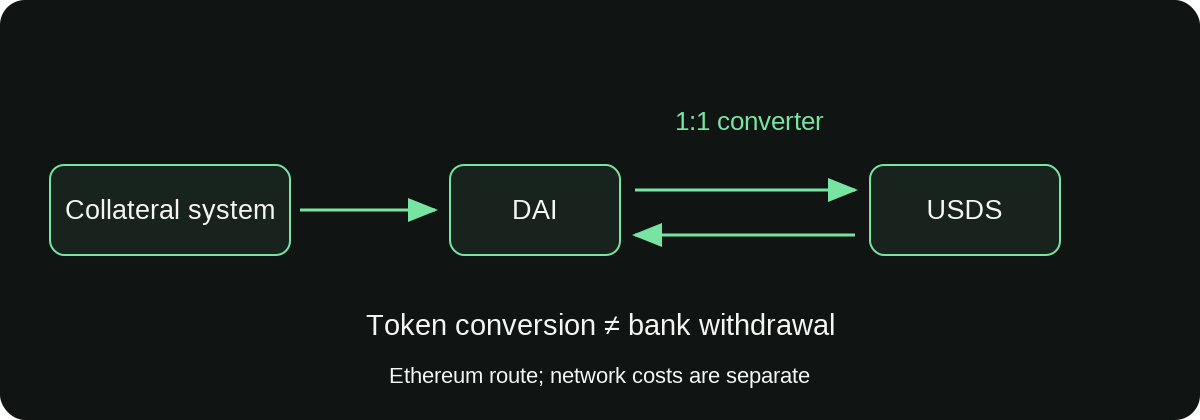
The DAI–USDS converter is not a bank withdrawal
Sky’s USDS documentation describes an Ethereum converter that exchanges DAI and USDS at a fixed one-to-one ratio without a conversion fee assessed by that route. Network transaction costs remain a separate consideration.
A conversion gives you another token. It does not put dollars into your bank, remove all shared collateral exposure or guarantee support on every exchange. Check the asset your destination actually accepts before changing it.
USDS also has its own contract design and deployment information. Review the exact network and contract rather than assuming any token with the same name is interchangeable. Protocol-level conversion availability and third-party platform support are separate facts.
There is also a distinction between a base stablecoin and a savings share. A share that accumulates value is not necessarily exchanged one-for-one with another savings token. Read the exchange-rate mechanism before comparing displayed balances.
Keep governance, savings and ordinary payments separate
A governance token represents participation in governance under its own rules. DAI itself should not be described as a general voting share in the protocol. Acquiring a governance token is a different exposure from holding a dollar-targeted asset.
Likewise, yield requires an additional arrangement. Merely receiving DAI in a wallet does not establish that it is enrolled in a savings mechanism. Depositing into a wrapper, lending market or other application changes the claim and adds another layer of conditions.
For a payment, the practical priority is recipient acceptance. Confirm whether they expect DAI, USDS or a particular wrapped form, and on which chain. A protocol relationship does not force a merchant or exchange to credit a different token.
The four-token selection guide puts this into a task-based comparison. It avoids treating every dollar-targeting token as a direct substitute in every application.
A DAI holder’s verification routine
Before acquiring DAI, locate its authentic contract through official documentation and inspect the receiving platform’s support. If you intend to use a conversion route, verify the deployed contract and transaction request rather than following an unsolicited migration link.
For larger or longer-term exposure, review current collateral disclosures and implemented governance changes. Record the observation date and distinguish assets from liabilities. Avoid publishing a live collateral ratio from an undated screenshot.
Finally, test the intended exit at an appropriate scale. Selling into a market, using a protocol converter and withdrawing fiat are different tasks. Knowing which one you depend on makes the limitations of each much clearer.
Questions about DAI’s changing ecosystem
Must I convert every DAI balance to USDS?
Do not infer a universal requirement from the existence of a converter. Check current official notices and your intended application. A route being available does not itself establish a compulsory migration for every holder.
Can an old DAI tutorial still help?
Basic concepts may remain useful, but verify current contract addresses, interfaces and parameters. Historical Maker terminology or screenshots should not substitute for present deployment instructions.
Does DAI always keep exactly the same price on every chain?
No. Venue liquidity, representations and transfer conditions can produce differences. Confirm the exact asset and executable quote rather than assuming the shared name guarantees identical local prices.