
Circle’s October USDC examination report, dated November 25, 2026, states reserve assets above the defined USDC circulation at its reporting dates. The relevant balances are October observations, not a live November 26 guarantee or a statement that every holder has identical direct-redemption access.
A useful USDC update separates reserve evidence, regulatory status and token usability. These categories can change on different schedules. A newly issued report can improve the available information while leaving an individual exchange’s network support or withdrawal restrictions unchanged.
The October report and its dates
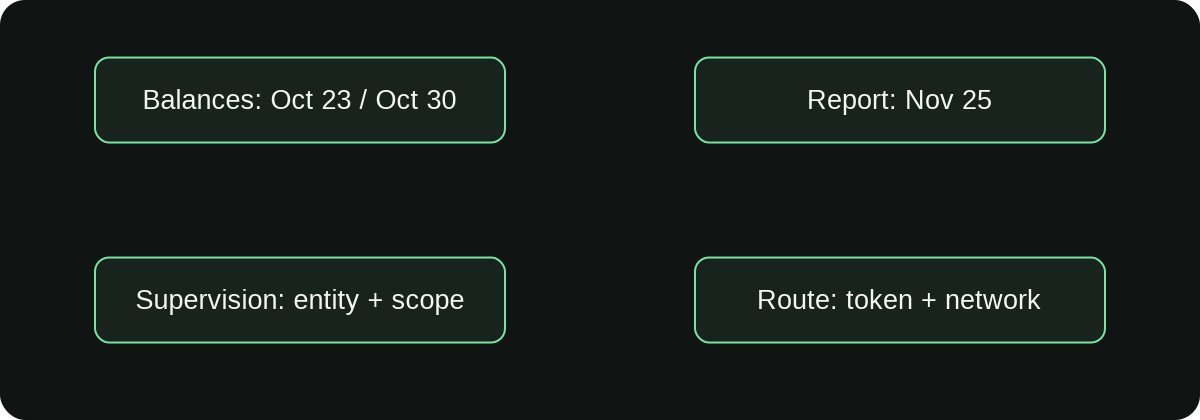
The examination report covers October 23 and October 30 at specified UTC cutoffs. For October 30, it lists approximately $70.532 billion of reserve assets against approximately 70.454 billion USDC in circulation under the report’s definitions.
The independent conclusion concerns management’s assertion and the stated criteria at those dates. Read that subject before interpreting a headline about full backing. The date of the accountant’s report does not turn the balances into observations from the day of publication.
| Date or field | Meaning |
|---|---|
| October 23 and October 30 | Defined balance-measurement dates |
| November 25 | Date on the examination and management reporting materials |
| Reserve assets | Assets valued and included under the stated criteria |
| Defined circulation | The report’s specified token-liability measure, with adjustments |
A comparison with a blockchain’s gross token count needs the report’s reconciliation. Technical supply fields and legally defined circulation can differ. Do not call every difference missing reserves without first checking the exclusions and timing conventions.
Weekly disclosures and monthly assurance answer different questions
Circle’s transparency page provides reserve-composition and issuance information alongside a monthly report archive. The displayed update date and the monthly examination dates should be preserved separately when assessing freshness.
Circle’s USDC product page displays 67.8 billion USDC in circulation dated November 23, 2026. This is an issuer-reported later supply observation, not the October examination’s reserve balance or an independent conclusion for November 23.
A dashboard can provide more frequent information, while an independent report adds a defined conclusion about a specific assertion. Neither should be described as performing the other’s job. A fresh dashboard figure does not automatically carry assurance for that exact time.
Circle also describes an audit of its corporate financial statements. That broader corporate reporting is different from a reserve-specific examination. The word audit should identify its actual subject rather than be used as a general badge that every token and transfer has been independently checked.
Read the reserve composition through liquidity
Reserve composition matters because token redemptions require operating access to dollars, not just a favorable aggregate valuation. Circle describes bank cash and short-duration instruments, including holdings associated with the Circle Reserve Fund. The categories have different custody and settlement arrangements.
Read the relevant fund and bank disclosures rather than assuming every dollar is immediately accessible through one bank account. Asset maturity, overnight arrangements and settlement cutoffs affect how liquidity operates under stress.
The token holder’s route adds another layer. An eligible institutional redemption channel, an exchange sale and a payment partner’s bank withdrawal are different processes. A reserve asset can support the issuer while the individual user still faces a platform hold or an unsupported local bank route.
The EU regulatory update has a defined entity and scope
Circle’s third-quarter filing reports that the EBA classified EU-issued USDC as a significant e-money token, with dual supervision effective November 12, 2026. It describes responsibilities shared between the EBA and the French ACPR.
This is a specific disclosure about the relevant European issuance and supervisory arrangement. It does not make every worldwide platform offering a USDC-branded asset authorized, or extend one jurisdiction’s protections automatically to an unrelated account elsewhere.
For an EU user, identify the actual issuer and service entity, then consult the applicable registers and terms. For a user outside the EU, start with the local rules instead of treating the European classification as a universal legal passport.
Native support is more important than the ticker alone
USDC can appear as native issuance or as a representation created through a bridge. Circle’s bridged-USDC materials explain that these arrangements can involve different dependencies. A wallet label alone cannot identify the claim being held.
Verify the official token identifier, current network status and receiving platform’s support. A chain announcement may describe planned or partial support, and an exchange can support fewer routes than the issuer’s overall network list.
Do not assume that a network supported historically remains open for every new deposit. Read migration and deprecation notices before transferring. A small test helps confirm the specific operational path, but it cannot validate the issuer’s solvency or eliminate bridge risk.
Translate the news into a holder checklist
For stored funds, review the reserve report, custody relationship and ability to exit. For a pending payment, confirm the recipient’s exact token and network. For a DeFi position, identify the additional protocol exposure instead of evaluating only Circle’s reserves.
The USDT-versus-USDC comparison helps organize those practical choices. Neither a brand preference nor a regulatory headline can replace the task-specific route. The best-supported choice depends on where the token must go and what the user ultimately needs to receive.
Keep the original documents and their dates when updating a larger holding decision. A later correction, new report or network change should modify the relevant assumption, not silently overwrite the historical record. Good reserve evidence and a usable transaction route are both necessary questions, and neither answers the other completely.
Frequently asked questions
Does buying Circle stock give me the same exposure as holding USDC?
No. Company equity and a stablecoin have different rights and economic purposes. A favorable result for the business does not imply that the stablecoin holder receives a proportional company profit or stock return.
Can a USDC balance show correctly while deposits are restricted?
Yes. A service can display a token balance while limiting a particular network or transaction type. Check the current deposit and withdrawal instructions rather than inferring full functionality from the visible balance.
Does a report signed this week supersede every earlier network notice?
No. A reserve report and a network notice address different subjects. A token migration, deprecation or service restriction remains relevant under its own terms until an applicable update changes it.