
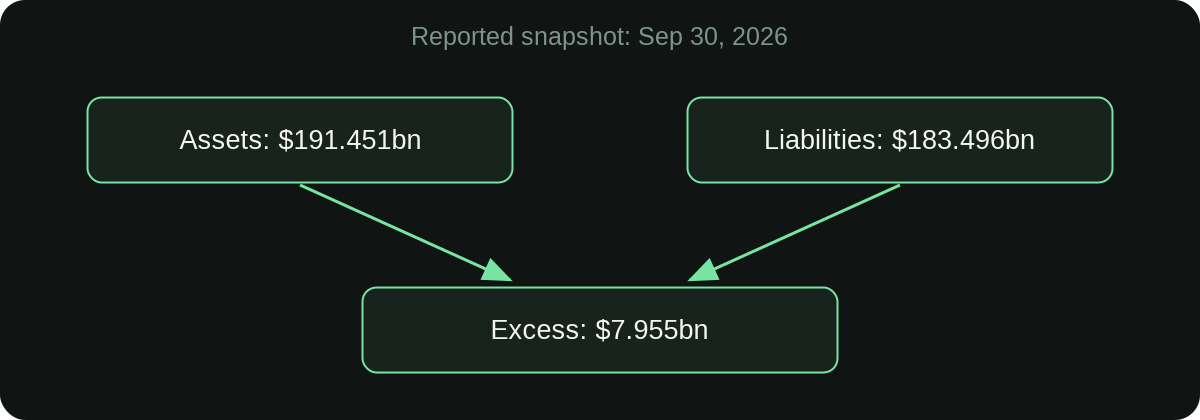
Tether’s Q3 2026 disclosure reports assets exceeding liabilities at September 30, with approximately $191.45 billion of assets and $183.50 billion of liabilities. The figures support a dated reserve assessment; they do not establish a live November balance or guarantee immediate redemption for every USDT holder.
The release was published October 30. Understanding the update requires separating the company’s reported financial figures, the independent assurance conclusion and the practical route by which a holder can exit. A profit headline alone answers none of those questions completely.
Reconcile the reported balance
The issuer’s release gives total assets of $191,451,091,374 and total liabilities of $183,496,460,904. Their difference is $7,954,630,470. Digital-token liabilities are a specified part of the reported liabilities, rather than a synonym for every balance-sheet item.
That subtraction provides a transparent check on the stated excess. It does not calculate the amount a particular user can withdraw on demand or establish how every asset would be realized under stress. The accounting subject and the user’s redemption entitlement are related but separate.
| September 30, 2026 reported figure | Amount |
|---|---|
| Total assets | $191,451,091,374 |
| Total liabilities | $183,496,460,904 |
| Assets less liabilities | $7,954,630,470 |
Use the unrounded numbers for reconciliation and rounded figures for an overview. Do not subtract a separately rounded token-supply headline from total assets and present the result as the exact reported buffer.
Read the assurance report rather than only the release
The linked BDO assurance report concerns the financial figures and reserves report under its stated criteria at September 30. It describes a reasonable-assurance engagement under ISAE 3000 Revised and explicitly limits the reporting date to that point in time.
Read the conclusion, criteria and emphasis paragraphs together. An independent conclusion can add meaningful evidence without becoming an audit of every future activity or a guarantee that market prices remain at one dollar. The report’s scope determines what the conclusion supports.
The term audited should not be used casually as a replacement for the actual engagement description. A reserve snapshot, an examination of a management assertion and a full financial-statement audit are not identical tasks. Their subjects and procedures need to be named accurately.
Separate asset quality from aggregate coverage
An aggregate excess of assets over liabilities does not describe every asset’s liquidity, maturity, valuation sensitivity or accessibility. A reserve assessment also asks what can be converted to cash, under which arrangements and over what timeframe.
The report lists approximately $122.84 billion in US Treasury bills, $19.08 billion in precious metals, $8.37 billion in Bitcoin and $14.18 billion in secured loans among its asset categories. Those categories should not all be described as bank cash.
Check the asset categories and valuation policies in the complete report. Do not turn a general reference to short-duration holdings into a claim that every reserve dollar is cash in a bank. Similarly, a secured asset can have different behavior from immediately available cash.
The right comparison is between the liquidity available and the obligations that may become payable. A company can report substantial assets while still depending on market and banking operations to meet withdrawals. The figures should be read as evidence within that operating system.
Do not confuse operating profit with holder income
The release’s operating-profit headline describes company performance. It is not a distribution promised to every USDT holder and should not be converted into an annual yield for simply keeping tokens in a wallet.
A separate service offering rewards may use lending, promotions or another arrangement. Evaluate that service’s counterparty, withdrawal terms and risk independently. Holding a token and lending it to earn a return create different exposures.
Company profitability can be relevant to the issuer’s financial position without settling the stability of every service carrying the token. An exchange insolvency or compromised wallet can affect a holder even when the issuer’s reported reserve figures remain unchanged.
Check the redemption route available to you
Tether’s published fee schedule states a minimum direct acquisition or redemption amount of $100,000 equivalent, alongside other requirements. That is different from selling a smaller amount through an exchange or broker under its own terms.
Account eligibility, verification, supported banking arrangements and processing can affect direct redemption. Do not interpret the existence of an issuer route as proof that an unverified retail wallet can send tokens and receive bank dollars immediately.
For an exchange exit, inspect the relevant bid, fees, withdrawal limits and bank route. The USDT-versus-USDC comparison frames the decision around the route you need rather than a universal winner. A reserve report cannot substitute for that operational check.
Follow later updates without rewriting the reporting date
Monitor later financial disclosures, legal terms and network notices. When a new report appears, preserve the previous figures and compare the same categories. A change in reporting scope or accounting definition should not be treated as an ordinary economic increase or decrease without explanation.
Keep the asset-measurement date separate from the release date and the date of your own review. This helps prevent an October publication about September balances from becoming a supposedly current November reserve figure through repeated reposting.
For a larger decision, use the reserve-proof procedure to record the legal entity, assertion, liabilities, evidence and exit terms. The result should identify supported conclusions and unresolved questions rather than compressing the whole assessment into the word safe.
A holder’s interpretation of the update
The Q3 figures provide a concrete snapshot and a reconciliation that readers can check. The assurance report adds a defined independent conclusion. Neither document removes custody, transfer, legal or market-liquidity risks that sit outside the balance-sheet comparison.
Evaluate USDT for the actual task: the amount, network, service and desired exit. If the task depends on instant small-value bank redemption, verify that route directly. A strong reserve headline and a workable personal withdrawal arrangement are different pieces of the decision.
Frequently asked questions
Does a token purchase give me shares in Tether?
No. A token holding is not an equity investment in the company. Do not interpret company profit or asset growth as a shareholder return owed to the token holder.
Can a market price above one dollar guarantee redemption profit?
No. Access, minimum amounts, fees, timing and execution can prevent a theoretical price difference from becoming a feasible transaction. Compare the whole route before calling the gap an arbitrage opportunity.
Should I compare this snapshot directly with an exchange proof-of-reserves page?
They can cover different entities, obligations and procedures. Establish the subject and definitions first. An exchange’s customer-asset disclosure is not automatically evidence about the issuer’s reserve backing, or vice versa.