
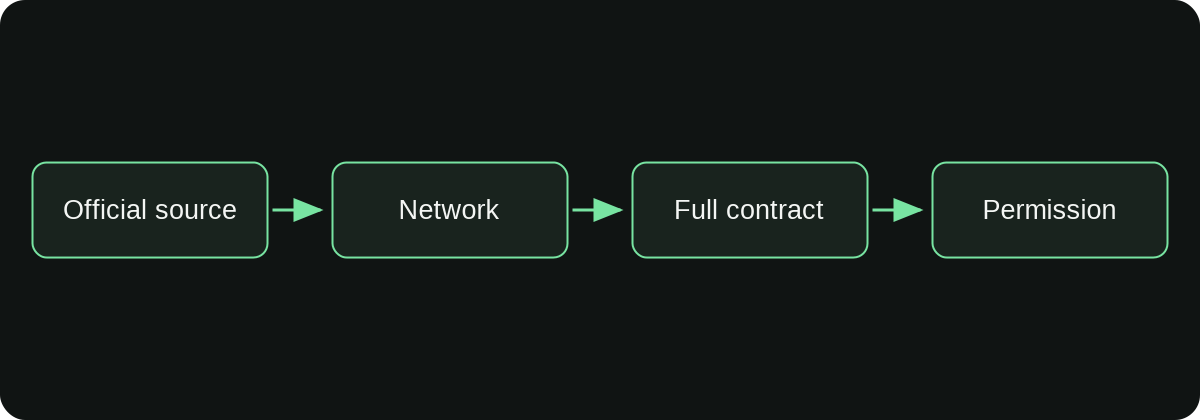
A stablecoin scam often substitutes a fake asset, website or transaction for something familiar. Verify the token’s network and contract through independent official sources, then inspect what your wallet is being asked to authorize. A logo and a dollar price are not proof.
The most useful defense is a verification sequence you can repeat under pressure. Treat unexpected urgency, unsolicited support and promises of guaranteed returns as reasons to pause, not reasons to complete a transfer faster.
Verify identity before price
Anyone may be able to create a token with a familiar ticker on a public network. Wallets and explorers can also display symbols that resemble established stablecoins. An apparent USDT or USDC balance might therefore represent an unrelated contract.
Start from the issuer’s independently located website. Find its official network and contract information, then compare the complete identifier with the asset you received or intend to buy. Do not use an address supplied only by the person selling you the token.
Network identity matters alongside the contract. A bridged token introduces an additional mechanism and may not be the issuer’s native asset. Circle’s explanation of bridged USDC helps distinguish those categories. A familiar name does not make their redemption routes identical.
For unfamiliar deposits, viewing public information is different from interacting with the token. You do not need to visit a website printed in its name or approve a contract to investigate it. Unwanted balances can be ignored while you verify independently.
Recognize the transaction hidden inside the message
Scammers may describe an action as verification, an airdrop claim or account repair while asking for spending permission. An approval can authorize a contract to move tokens later. A signature may carry consequential permissions even when no ordinary transfer appears on the screen.
Inspect the spender, asset, amount and network. Ask whether each is necessary for your intended task. A simple support conversation should not require an unlimited token allowance or a signature you cannot explain.
The Uniswap approval guide distinguishes approval-related steps from a swap. That distinction helps you notice when a page asks for authority beyond what you expected. It does not establish that every approval request is safe or that every protocol uses the same sequence.
A wallet warning is another piece of evidence, not a certificate. Newly created malicious sites may not be recognized immediately. If your understanding of the action and the wallet request disagree, stop rather than assuming the interface is merely technical.
Separate real gas from invented release fees
A blockchain transaction can require a network fee. A service may also publish legitimate trading or withdrawal charges. Neither fact makes an unsolicited request for a separate “tax,” “unlock deposit” or “liquidity verification payment” trustworthy.
Check where the fee appears and who receives it. Does the official service disclose it within your own account? Does a wallet show a normal network charge, or are you being instructed to send tokens to a stranger’s address?
The FTC’s cryptocurrency scam guidance warns about impersonation and payment demands. Do not let a convincing support profile replace independent contact through a known service. A copied conversation can be as misleading as a copied website.
Fake dashboards can show profits that never existed. If a platform requires repeated extra payments before allowing withdrawal, the displayed balance is not evidence that money is recoverable. Paying another fee can increase the loss without improving your claim.
Respond according to what was exposed
If you only opened a suspicious page without connecting or signing, close it and inspect your device for unexpected downloads or extensions. Do not assume every page view empties a wallet, but investigate any installation or credential entry separately.
If you granted an allowance, use a trusted interface to review and revoke the relevant permission where possible. Disconnecting the site alone may leave existing authority intact. Pending transactions and signatures can require additional investigation.
If your recovery phrase or private key was disclosed, consider the wallet compromised. Changing the app password does not replace the key. A secure recovery plan may require a new wallet created in a clean environment; moving assets from a compromised wallet can itself be contested by an attacker.
Preserve public addresses, hashes, screenshots and messages. Report the incident to the relevant provider and authorities through verified channels. Never include a seed phrase in a report, even when someone claims it is needed to prove ownership.
Watch for the second scam after the first loss
Recovery fraud targets people who are already distressed. A stranger may claim to trace stolen stablecoins or work with an exchange, regulator or law firm, then demand payment before releasing funds.
The FTC’s recovery-scam warning describes this advance-fee pattern. An investigator’s ability to identify a transaction does not demonstrate an ability to reverse it. Public blockchain information is available to scammers too.
Evaluate any assistance through independently verified professional details and clear terms. Do not install remote-control software or sign transactions because someone has correctly repeated your wallet balance. Knowledge of public data is not privileged access.
Build a short household rule: nobody supplies wallet secrets, pays surprise release charges or changes payment addresses solely on a message. For legitimate storage controls, see the wallet security guide. If an authentic token is falling rather than fake, the depeg response plan addresses a different problem.
Questions that often arise after suspicious contact
Can a scammer fake a successful transaction screenshot?
Yes. Confirm the hash independently on the correct explorer and check the receiving service’s credited balance. An image, email or sender-side status is not a substitute for those records.
Should I paste my private key into a token-verification tool?
No. Public contract and transaction checks do not require private keys. A site requesting them for token verification is asking for control of funds, not merely identifying an asset.
Does a verified social-media account prove a promotion is legitimate?
No. Accounts can be impersonated or compromised. Navigate independently to the issuer or service, compare the announcement and avoid treating follower count or a badge as transaction authorization.