
A stablecoin depeg changes what your tokens can buy, even if their quantity stays unchanged. The effect on your money depends on whether you hold tokens outright, owe them, pledge them as collateral or need to spend them immediately.
A portfolio app may continue showing a one-dollar valuation after a tradable market has moved. Start with the actual position and an executable price, then calculate the consequence for that position rather than applying one percentage to everything.
Token count and purchasing power are different measurements
For an unleveraged wallet balance, a simple estimate is quantity multiplied by the available selling price. Fees, spread and market depth determine how much of that value you could actually receive. A tiny last trade may not support selling your full balance.
For illustration, 5,000 tokens selling at $0.94 are worth $4,700 before costs, rather than $5,000. The $300 difference is a market-value decline; the wallet still contains 5,000 tokens. These figures are hypothetical, not current prices.
If a later sale occurs at that price, the market decline becomes part of the realized outcome, subject to acquisition cost and relevant accounting rules. Continuing to hold does not restore the spending power merely because no sale has occurred.
A temporary market discount and a permanent issuer shortfall can initially produce similar-looking charts. The Federal Reserve’s analysis of the 2023 USDC episode illustrates how banking access can transmit stress. One historical recovery does not establish that another token must recover.
Borrowers must value collateral and debt separately
A loan can become more dangerous when a stablecoin used as collateral falls while the debt stays stable. Your liability has not shrunk simply because the collateral carried a stablecoin label when deposited.
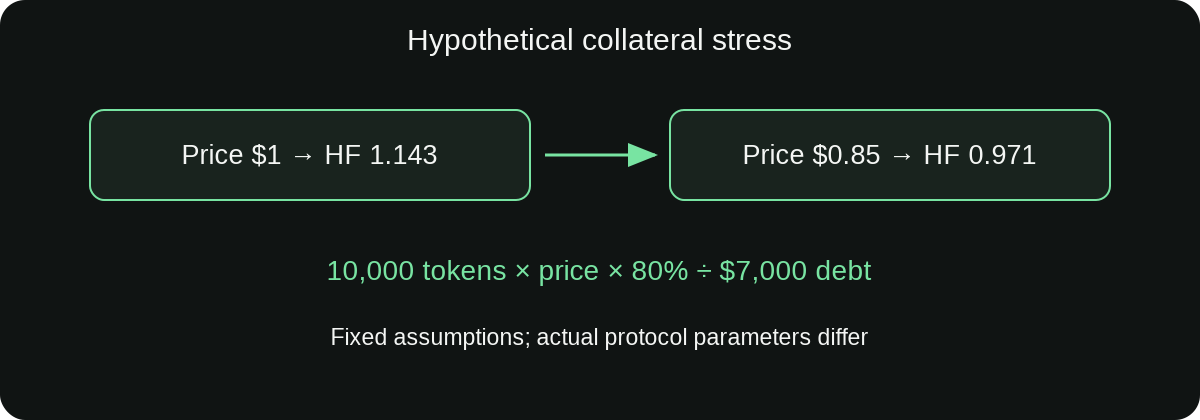
Consider a simplified position with 10,000 collateral tokens, a fixed 80% liquidation threshold and $7,000 of debt. At a $1 collateral price, the illustrative health factor is 10,000 × 1 × 0.80 ÷ 7,000, or about 1.143. At $0.85, it becomes about 0.971.
Under this simplified model, that crosses below one. Actual eligibility depends on the protocol’s oracle, thresholds, interest, debt valuation and other settings. This is a sensitivity calculation, not a simulation of a real account or a recommendation to borrow.
Aave V3’s health-factor documentation explains the role of collateral value and liquidation thresholds in its borrowing framework. A market discount matters through the protocol’s own valuation rules, which need not change at exactly the same moment as an exchange quote.
The reverse case deserves separate treatment. If you owe the depegging token, buying it back at a discount might reduce the fiat cost of repayment. But repayment requires the correct asset and available liquidity. Do not assume an apparent discount can be captured before prices, interest or market conditions change.
Lending and liquidity positions can hide additional exposure
A lending receipt represents a claim through a protocol, not simply loose tokens in your wallet. The position may earn token-denominated interest while its dollar value declines. Withdrawal availability adds a second question beyond valuation.
A liquidity-pool position changes its asset mix as others trade. If one stablecoin weakens, your position can accumulate more of it. Calculating half your original deposit at the weaker price and half at the stronger price may therefore misstate your current exposure.
Inspect the withdrawable quantities and quote their sale separately. Include accrued fees, incentives and gas to see the combined result. Uniswap’s documentation on returns provides a model-specific explanation of how pool returns differ from holding assets outside a pool.
Do not apply a standard full-range constant-product calculation to every concentrated-liquidity or stable-swap design. The relevant position data and mechanism determine the result. A generic chart of the stablecoin cannot reveal the composition of your individual pool share.
Payments are affected by deadlines and quote terms
Suppose you need a fixed $1,000 payment while your tokens trade at $0.94. Ignoring fees, you would need about 1,063.83 tokens to buy that dollar amount. A balance of 1,000 tokens no longer covers the bill at that rate.
A merchant or payout provider may instead honor a previously agreed quote, requote it or suspend acceptance according to its terms. Read the actual agreement rather than assuming either party must accept the token at its target.
For local-currency expenses, separate the token’s dollar discount from the exchange-rate movement between dollars and your currency. Both can affect the final amount. Record the rates and times used so that you can explain why the payment changed.
Cash needed today and an asset held without an immediate deadline create different constraints. That does not determine which trading decision is right, but it does identify which obligations cannot wait for an uncertain recovery.
Build an exposure sheet before choosing a response
List each wallet, platform, loan, pool and pending payment. Record the asset quantity, current usable route, relevant price source, debt and deadline. Group bridged or wrapped versions separately when they introduce different claims.
Then calculate both market value and available cash proceeds. An issuer claim that might eventually settle at par does not necessarily fund an expense due this afternoon. Conversely, a poor quote on one small pool is not automatically the value obtainable everywhere.
This position-level method adds information that a headline depeg percentage lacks. For diagnosing whether the event is local or broad, see the depeg explanation. For an ordered incident checklist, use the response guide.
Position-specific questions
Can my stablecoin gain in local-currency terms during a dollar depeg?
Yes, if the dollar strengthens enough against your local currency to outweigh the token’s dollar discount. Calculate both movements with consistent timestamps rather than treating the local gain as evidence that the peg remained intact.
Does a stablecoin liability always stay valued at one dollar?
No. Loan accounting and protocol valuation rules determine its treatment. Inspect the debt asset’s oracle and repayment terms rather than inferring the liability from a wallet app’s display.
Do I lose the same percentage if my token trades above its peg?
A premium can benefit an existing seller but disadvantage someone buying tokens for a fixed obligation. Assess your direction and transaction costs; a price above target is not automatically favorable to every user.