
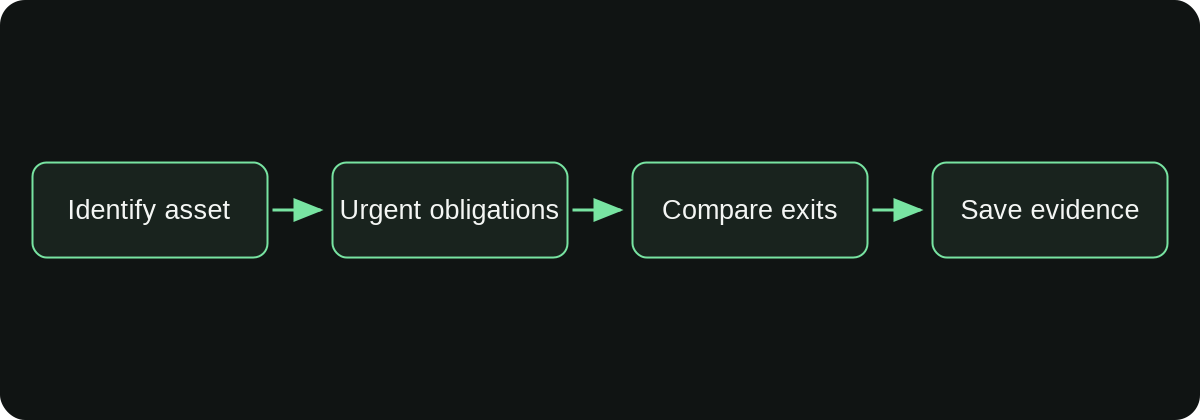
When a stablecoin loses its peg, first identify your urgent obligations and verify a usable exit price. Then assess whether the problem concerns the issuer, a particular market, a bridge or your platform. There is no single automatic sell-or-hold answer for every position.
This response plan prioritizes decisions during an incident. It does not assume that recovery is guaranteed, nor that the worst quote on one venue represents every holder’s available outcome.
First establish what you actually own
Record the exact asset, network, contract and location of each affected balance. Separate native tokens from bridged representations and distinguish loose wallet holdings from lending receipts or liquidity-pool positions.
A price alert may refer to a different token representation or a thin trading pair. Compare independent venues and the relevant issuer or protocol announcements. Look for consistent evidence rather than treating one screenshot as a complete diagnosis.
The Federal Reserve’s analysis of the 2023 USDC episode illustrates how a banking event can affect stablecoin markets. Use that history to ask better questions, not to promise that a current event will follow the same recovery path.
Avoid connecting a wallet just to read an announcement. Public information can normally be inspected without granting spending permission. An incident creates opportunities for fake rescue pages and urgent “migration” instructions.
Prioritize obligations with a clock
List what requires action soon: collateralized borrowing, a fixed payment, a redemption deadline or a platform withdrawal cutoff. A loan nearing liquidation can create a different urgency from an unleveraged balance without an immediate spending need.
For debt positions, inspect the protocol’s live valuation and health measures. The Aave V3 health-factor documentation is one example of a deployment-specific framework. A centralized portfolio app’s price may not be the price used to assess your loan.
Consider the feasibility and consequences of reducing debt or adjusting collateral under that protocol’s actual rules. Adding more of the same distressed asset may concentrate exposure rather than solve it. A transaction that would help in theory is not useful if it cannot complete before the relevant condition changes.
For essential expenses, establish the amount of usable money needed and the deadline. Do not budget on a presumed peg restoration date. Separate resources available for immediate bills from assets whose outcome remains uncertain.
Compare executable routes rather than displayed prices
An exchange quote, a DEX swap and issuer redemption are different routes. For each available option, record eligibility, size, net proceeds, expected timing and failure conditions. A route you cannot access should not determine your decision.
For a market sale, obtain an amount-specific quote. Check order-book depth or minimum swap output, fees and the asset you would receive. Exiting one unstable asset into another introduces a new claim rather than necessarily producing bank money.
For issuer redemption, use official contact details and terms. Understand whether your status and amount qualify and what happens after tokens are submitted. A request acknowledged by an intermediary is not the same as cash already available in your bank.
For platform withdrawal, confirm the supported network and destination. A platform-specific disruption might make moving the authentic token relevant, while an issuer-level shortfall will not disappear merely because the token changes wallets.
Use the bank cash-out guide to follow the final settlement stages. Do not describe a token sale as a completed cash-out while a bank withdrawal remains pending.
Decide using scenarios you can afford
Compare at least three possibilities: a recovery, an extended discount and a deeper impairment. Do not attach invented probabilities. Instead, ask how each would affect your payments, debt and remaining resources.
For illustration, suppose you hold 3,000 tokens and the executable price is $0.92. Selling all would produce $2,760 before costs. A later return to $1 would value the same quantity at $3,000, while a fall to $0.70 would value it at $2,100. These are arithmetic scenarios, not forecasts.
A partial action can also have trade-offs. Reducing exposure may secure some liquidity while retaining uncertain value, but multiple transactions add costs and may complicate records. The appropriate choice depends on constraints and evidence, not on a universal percentage rule.
Write down your reason and the facts you relied on. That helps prevent a stream of contradictory social posts from turning a deliberate response into repeated impulsive trading.
Protect access while investigating
Keep enough native network currency for necessary transactions where applicable. Verify addresses through an independent channel and read signing requests. Do not raise slippage blindly until a swap completes; the accepted minimum can materially worsen the result.
Be suspicious of anyone promising priority redemption or recovery after an advance payment. The FTC’s recovery-scam guidance explains this pattern. Knowing your wallet address or balance does not prove that a stranger can help recover funds.
If an incident also involves compromised keys, treat security as its own emergency. Revoking an allowance does not replace an exposed private key. Use a clean environment and verified assistance rather than following a recovery script supplied through unsolicited chat.
The scam verification guide addresses those security distinctions. A genuine depeg and a fraudulent recovery offer can occur at the same time.
Preserve evidence and review the result
Save announcements with timestamps, original account notices, transaction hashes, quotes, order fills and support references. Keep sensitive identity documents within appropriate secure channels, separate from public incident reports.
After the immediate decision, reconcile what remains: token quantities, receipt positions, outstanding debt and bank balances. Check for open orders or permissions that no longer serve a purpose. Do not assume a transaction request succeeded merely because it was signed.
Review your dependency map once conditions stabilize. Did several holdings rely on the same issuer, bridge or exchange? Did funds intended for bills depend on a route that closed outside bank hours? Improve those operational choices without pretending that any arrangement can remove every risk.
Questions during a fast-moving incident
Should I follow a poll showing most holders are not selling?
A poll does not show executable liquidity, holder obligations or representative behavior. Use verifiable evidence and your own constraints; other participants may have different access or undisclosed positions.
Can a stop order guarantee an exit near one dollar?
No. Triggering and execution differ. A market-style stop can fill below expectations, while a stop-limit order can remain unfilled. Gaps, thin liquidity and venue interruptions can affect either route.
What if trading is paused but transfers still work?
Verify why each function is available and whether the destination accepts the asset. A transfer might change custody without restoring liquidity. Confirm the complete receiving and exit route before paying to move tokens.