
A stablecoin run can develop when holders doubt that they can obtain usable money promptly, even before the final size of any reserve loss is known. The March 2023 USDC episode shows how banking access and secondary-market prices can interact during stress.
The lesson is not that every reserve-backed token will recover, or that every price discount proves insolvency. It is that reserve value, immediate access and the route available to each holder must be examined separately.
The historical trigger was a banking exposure
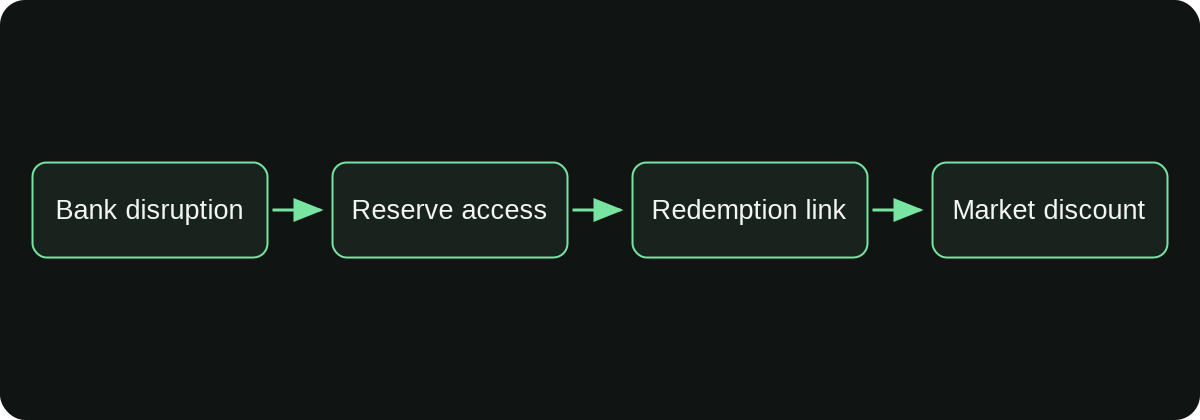
The Federal Reserve’s February 2024 analysis records that Circle announced on March 10, 2023 that it had been unable to transfer out a portion of USDC reserves held at Silicon Valley Bank before regulators took control. USDC subsequently traded away from its dollar target.
The same research distinguishes the primary market, where eligible counterparties interact with issuance and redemption, from secondary markets, where other users trade. Those routes did not provide every holder with identical options during the disruption.
This is a dated case study. It is not a statement that the same reserve exposure exists today. For current issuer evidence, use the reserve-report directory and preserve each report’s original measurement date.
How an access concern becomes a market problem
Imagine a holder who needs dollars immediately while a redemption route is uncertain or unavailable. They may sell tokens to another buyer at a discount. The buyer must judge not only eventual recovery value but also waiting time, risk and their own access to redemption.
If many sellers want immediate liquidity while fewer buyers can warehouse that uncertainty, the market price can fall. The discount compensates buyers for risks and constraints; it does not by itself reveal precisely how much reserve value has been lost.
Normally, arbitrage can connect secondary-market prices with a usable primary-market route. During disruption, that connection may weaken. A theoretical right to receive a dollar is less effective at stabilizing a market if the relevant participants cannot exercise it promptly.
The distinction explains why a weekend or operational interruption matters. A blockchain can keep processing transfers while banking, risk approvals or issuance systems operate under different constraints. Continuous token trading does not guarantee continuous access to the assets supporting it.
Distinguish three different questions about backing
First ask whether the assets exist and belong within the relevant reserve arrangement. That is a question about the claim and evidence, not merely an issuer’s overall reputation.
Next ask what those assets could be realized for under the circumstances. A security’s accounting value, market value and immediate sale proceeds may differ. Costs and forced-sale conditions can matter during stress.
Finally ask when eligible holders can receive proceeds. A sound asset might be temporarily inaccessible through a bank or operational process. Conversely, a working redemption interface does not prove that every underlying asset remains valuable enough to meet all claims.
These questions lead to different evidence. A bank resolution announcement addresses something different from an accountant’s point-in-time reserve conclusion or an exchange’s live order book. Combining them without preserving their scope can create false certainty.
Why another stablecoin can be affected
A system may hold the affected token as collateral or use a conversion route linked to it. The connection can transmit stress directly. Other assets may also move because users change preferences or question similar dependencies.
The Federal Reserve’s later study of the SVB episode examines such linkages, including DAI’s peg-stability mechanisms. It supports investigating connections rather than assuming that different tickers represent independent risks.
For a holder, trace both asset and service dependencies. Two tokens stored on one platform share that platform’s access risk. Two protocols using the same stablecoin collateral may share exposure even if their interfaces look unrelated.
Do not infer the size of contagion from a single chart. Identify what each arrangement holds, owes or permits users to exchange. That gives a causal explanation that a synchronized price movement alone cannot provide.
What deposit protection does and does not establish
A bank resolution outcome concerns specified depositors and legal arrangements. It should not be generalized into a standing government promise to reimburse every stablecoin holder in every future event.
The FDIC’s crypto fact sheet distinguishes bank deposit insurance from protection against a crypto company’s failure. An issuer using a bank does not automatically turn each token into a personally insured deposit.
When reading a rescue or resolution headline, identify the beneficiary and covered obligation. Ask how that outcome affects reserve access, then separately ask how proceeds reach your own account or wallet.
This avoids two opposite mistakes: assuming a favorable banking outcome guarantees every intermediary, and assuming a market discount proves no legal recovery path exists. The underlying documents determine what can be concluded.
Use the case to improve operational planning
For funds intended for imminent expenses, investigate the complete conversion route in advance. Record eligible providers, account limits, supported networks and plausible processing times. The ability to transfer tokens is only one stage.
For a portfolio, map shared banks, issuers, bridges and custodians where disclosed. Diversification should address failure paths rather than count logos. A reserve report can inform that map but cannot replace it.
For an actual incident, prioritize obligations before reacting to headlines. A collateralized loan may need attention sooner than an unleveraged balance. The response plan orders those checks without promising a universal trading answer.
The durable lesson from this case is a question: what must keep working for your specific claim to become spendable money? Answering it gives you more useful information than assuming that a familiar stablecoin always behaves like cash.
Questions about interpreting historical runs
Can a falling market price reveal an exact probability of recovery?
Not on its own. Prices also reflect liquidity, access, risk tolerance and trading frictions. A discounted quote is information, but translating it into a precise recovery probability requires assumptions that should be stated and tested.
Would faster public reporting prevent every run?
No. Better information can reduce uncertainty, but it can also reveal a real exposure that prompts withdrawals. Reporting quality and the underlying ability to meet claims are separate components of resilience.
Should I treat every future banking headline as another SVB case?
No. Compare the actual reserve exposure, legal treatment and available liquidity. Similar headlines can conceal different claims and outcomes; a historical analogy is a starting question, not a completed analysis.