
The latest report you can verify is the newest authentic document in the issuer’s archive, with its measurement dates preserved. It is not necessarily a report measuring today’s reserves. Use the directory below to locate selected USDT, USDC and PYUSD evidence checked on November 26, 2026.
This is a dated reading guide, not a live backing dashboard or a claim to catalogue every stablecoin. Its purpose is to prevent mismatched dates and definitions when you compare disclosures.
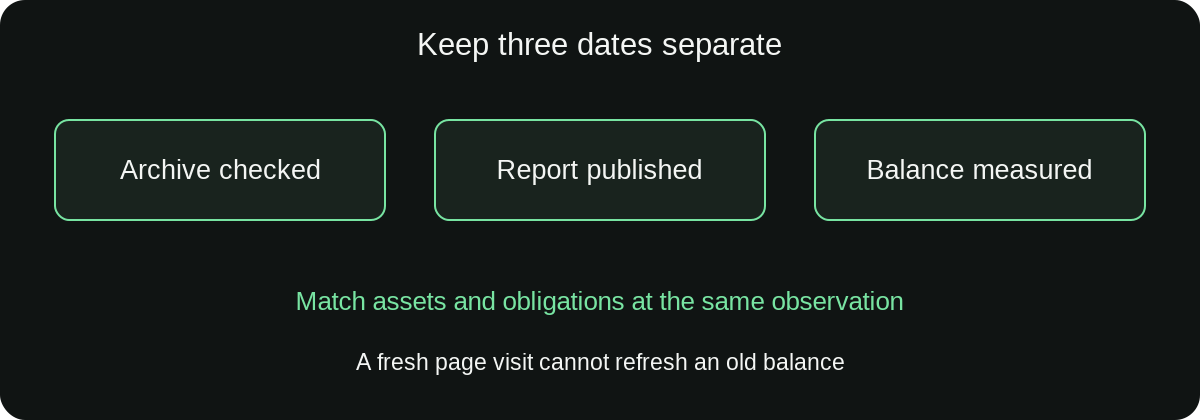
Use three dates for every document
Record the date you checked the archive, the date the report was signed or published and the date or times the financial information measures. They serve different purposes.
The archive check tells readers when you looked. The signature or publication date shows when the document became available or was completed. The measurement date identifies the financial snapshot supporting the conclusion.
A newer upload can examine an older balance. A dashboard can show a recent figure without independent assurance at the same time. Neither makes the other false, but they should not be combined into a single undated number.
For an independent report’s terminology, use the audit-versus-attestation guide. This article concentrates on locating and maintaining the report record.
Selected documents available at the check date
| Asset | Verified document | Measurement window used here | Important boundary |
|---|---|---|---|
| USDT | September financial information with BDO assurance | September 30, 2026 | Defined company financial information, not simply gross token supply |
| USDC | October examination dated November 25 | October 23 and October 30, 2026 | Report-defined circulation and reserve assets |
| PYUSD | September redemption-assets report linked in archive | September 17 and September 30, 2026 | Redeemable token definition and specified redemption assets |
When a document measures more than one date, pair each asset balance with the obligation from that same observation. Mixing an earlier asset total with a later liability figure creates a comparison the accountant did not examine.
These rows are not ranked by safety. Different measurement windows and obligation definitions prevent a clean comparison based only on which surplus appears largest.
USDT: follow the release to the independent document
Tether’s October 30 update points to September 30 information. The BDO report and attached figures provide the engagement context.
Reported assets of $191,451,091,374 minus total liabilities of $183,496,460,904 produce $7,954,630,470. Preserve “total liabilities” as the comparison definition rather than replacing it with an unrelated supply dashboard.
For report maintenance, save both documents and record which numbers came from the attached financial information. A company release may emphasize profit or reserve changes, while the independent document defines the subject actually examined.
Do not label September balances as current November backing simply because the release remains prominent in search. The USDT reserve analysis discusses composition and personal redemption access separately.
USDC: distinguish the October examination from the dashboard
The Circle transparency archive links monthly examinations alongside other reserve information. The October document dated November 25 measures October 23 and October 30 at 11:59 p.m. UTC.
At October 30, reported reserve assets were $70,531,865,375 against $70,453,807,800 of circulation under the report’s criteria. The difference is $78,057,575. Gross blockchain supply is not silently substituted for the defined circulation field.
A subsequent issuer dashboard may describe a different date. Retain that observation separately and state whether you could retrieve its actual numeric fields. An attractive chart with unavailable values does not justify filling the gap from a cached search preview.
The USDC news article handles the issuer’s financial and regulatory context. Here, keep the monthly document identifier and measurement window clear enough for another reader to reproduce the lookup.
PYUSD: an archive label is not necessarily a report link
At the check, Paxos’s PYUSD archive had a linked September 2026 report, while October and November appeared as unlinked month labels in the retrieved view. That observation does not prove that no other document exists elsewhere.
The September report measures September 17 and September 30 at 5 p.m. Eastern. Its September 30 redemption assets of $2,754,709,360 and redeemable tokens of 2,747,625,868 differ by $7,083,492 before subsequent reconciliation items.
When refreshing the directory, check whether a later link has appeared rather than merely changing the article’s date. Preserve the report’s own issuer name and definitions. Current branding should not obscure the legal entity named in a historical document.
Maintain a report ledger that can be checked
Use fields for token, issuer, source URL, archive check date, report date, measurement times, asset total, obligation total and definition. Add a note for missing fields or differences from the previous report.
If you archive a local copy, retain its original filename and record a checksum if useful for version control. That can help detect a changed file, but it does not verify the financial contents independently.
Before calculating trends, compare entity scope, valuation policies and token exclusions. If definitions change, mark a break in comparability. A spreadsheet that automatically divides every asset total by every supply total can produce a precise but misleading ratio.
Finally, link the document back to the holder’s task. Reserve coverage does not establish exchange solvency, immediate market depth or your own redemption eligibility. Those questions need additional evidence even when the report itself is authentic and favorable.
Questions about finding newer evidence
Should I remove an older report after a new one appears?
Keep a historical record while clearly identifying the newer document. Older reports help explain changes and preserve evidence of what was available at the time; they should not remain mislabeled as current.
How should I record an official correction to a published report?
Retain the original and corrected versions with their retrieval dates, and identify the changed fields. Explain whether the correction affects your calculations or interpretation rather than silently replacing the old numbers in a historical comparison.
What if two authentic reports use different reserve categories?
Preserve both classification systems and reconcile them where possible. Do not force unlike categories into one line without explanation. A transparent comparison can leave some fields incomparable rather than manufacturing a uniform ranking.