
USDT and USDC can be subject to issuer controls, including address restrictions under their terms and applicable law. Holding them in a self-custody or hardware wallet does not necessarily remove those controls. An exchange account restriction is another, separate layer.
If a transfer fails, identify which layer is responsible before concluding that the issuer has frozen your money. Gas, network support, account reviews and token permissions can produce different problems requiring different responses.
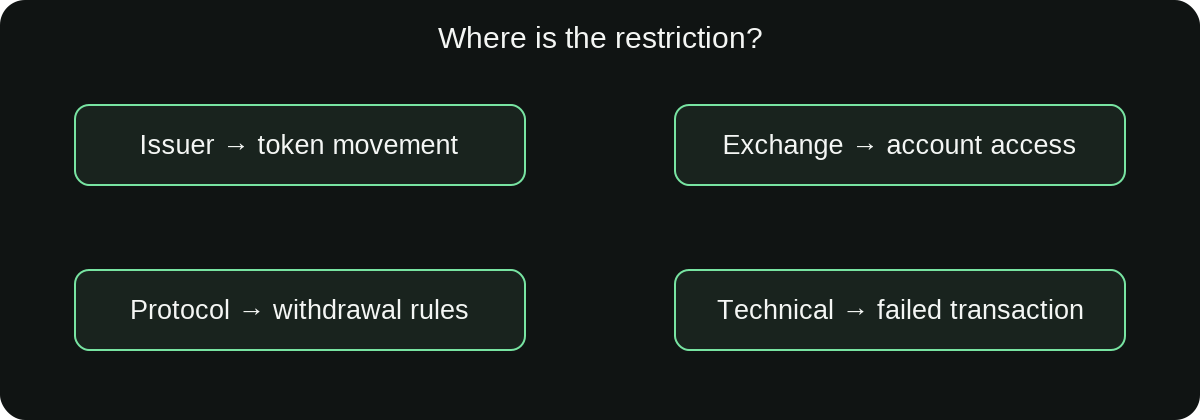
Separate four meanings of “frozen”
An issuer-level restriction concerns the token’s control mechanism. Depending on the asset and deployment, it can prevent movement to or from specified addresses. Your private key may still work for unrelated assets even when the restricted token cannot move.
A custodial restriction concerns a service’s account records and policies. The exchange may pause withdrawals or require information while the token itself continues moving normally elsewhere. The balance shown in your account is not the same as direct control over an on-chain address.
A protocol restriction can arise from a lending position, paused contract or withdrawal queue. A wallet may display a receipt token while the underlying assets are unavailable under that application’s conditions.
Finally, a technical failure can look like a freeze without being one. Insufficient native gas, a wrong network or a failed transaction request needs troubleshooting rather than a legal appeal to an issuer.
What Circle’s terms and policy establish
Circle’s USDC terms reserve address-blocking powers and discuss restrictions connected with prohibited activity and valid legal orders. The relevant legal entity, user category and version of the terms matter.
Circle’s blocklisting help describes address-level restrictions and directs users to its policy and terms. It does not promise that every theft report leads to an immediate block or reimbursement.
The practical consequence is narrower than “Circle controls my whole wallet.” A token-specific restriction does not itself give the issuer your recovery phrase or control over every other asset at that address. But your ability to sign transactions does not override the token’s own transfer rules.
Do not assume another chain or a bridged representation removes the issue. Different deployments can introduce additional operators and controls. Identify the actual token rather than reasoning solely from its symbol.
What Tether’s materials establish
Tether’s legal terms describe suspension, termination and token-freezing powers in specified circumstances. Its 2026 relevant information document also discusses attempts to freeze tokens in external wallets in response to relevant authorities.
This means that private-key custody and issuer restrictions are separate questions for USDT too. A hardware wallet can protect signing keys while the asset remains subject to administrative or legal controls.
Read the exact current terms when assessing a real event. Do not turn the existence of a power into an unsupported claim that a particular address is restricted, or that an issuer will exercise the power for every disputed payment.
Freezing and recovery are also different outcomes. Restricting further movement does not automatically determine ownership, satisfy competing legal claims or return assets to the person who filed the first report.
Diagnose a failed transfer with observable evidence
Record the exact token, chain, address and transaction hash. Check whether a transaction was broadcast, whether it failed on-chain or whether the service refused to create it. These stages point toward different responsible parties.
If there is no hash, inspect the sending service’s account notice and withdrawal status. If an on-chain transaction failed, inspect the reported reason, native gas balance and token-specific conditions through a trusted explorer or official support channel.
Compare the network and contract with issuer documentation. An unsupported wrapped token or fake asset may not be governed by the issuer you expected. Contacting the wrong company delays the investigation and can expose you to impersonators.
Do not keep resubmitting transactions blindly. Repeated attempts can incur charges without resolving the restriction. Preserve the first useful failure evidence and ask a precise question about the layer involved.
Use a documented support route
For an exchange restriction, contact the exchange through your verified account. Ask what information it needs, which function is restricted and whether there is a reference for review. Provide documents only through the legitimate process.
For suspected theft, preserve addresses, hashes, messages and proof of ownership. Report promptly to relevant providers and law enforcement where appropriate. An issuer or service may need valid legal process; a public accusation is not a substitute for it.
Do not pay an unsolicited “unfreeze agent.” Someone knowing your public balance has not demonstrated the authority to remove a restriction. The scam guide explains why recovery offers require independent verification.
This is also why attempts to evade a lawful restriction by using other identities or concealed routes are not a reliable solution. Resolve the actual account, contractual or legal issue with the responsible party.
Incorporate controls into your holding decision
A useful storage plan considers both who can sign and what the asset permits. Self-custody changes exposure to a custodian; it does not rewrite an issuer’s contract. Review both before choosing where to keep operational funds.
Do not assume an asset without the same issuer control is automatically safer. It may introduce collateral, governance, smart-contract or liquidity risks instead. Compare the complete claim and use case, not just the presence of a freeze function.
The wallet storage guide covers recovery and permissions. The alternative-assets comparison helps distinguish key control from other reasons you may prefer bank money or another instrument.
Questions about restricted assets
Can I still receive unrelated tokens at an address with blocked USDC?
Potentially, because a restriction can be asset-specific. That does not establish that every other transaction is permitted or safe. Inspect each asset and relevant service rather than treating the address as universally disabled.
Does a test transfer prove my tokens can never be restricted later?
No. It demonstrates that a particular transfer worked at that time. It does not remove future legal orders, policy actions or changes in the relevant system.
Can a wallet provider remove an issuer block by resetting the app?
Resetting a local interface does not change a token contract or legal restriction. Before reinstalling, protect your recovery information and investigate the actual failure; avoid software claiming to bypass restrictions for a fee.